A kW, kVA AND kVAR GUIDE
What is a power factor charge on an electric bill?
BillMellow Editorial · Updated November 8, 2026
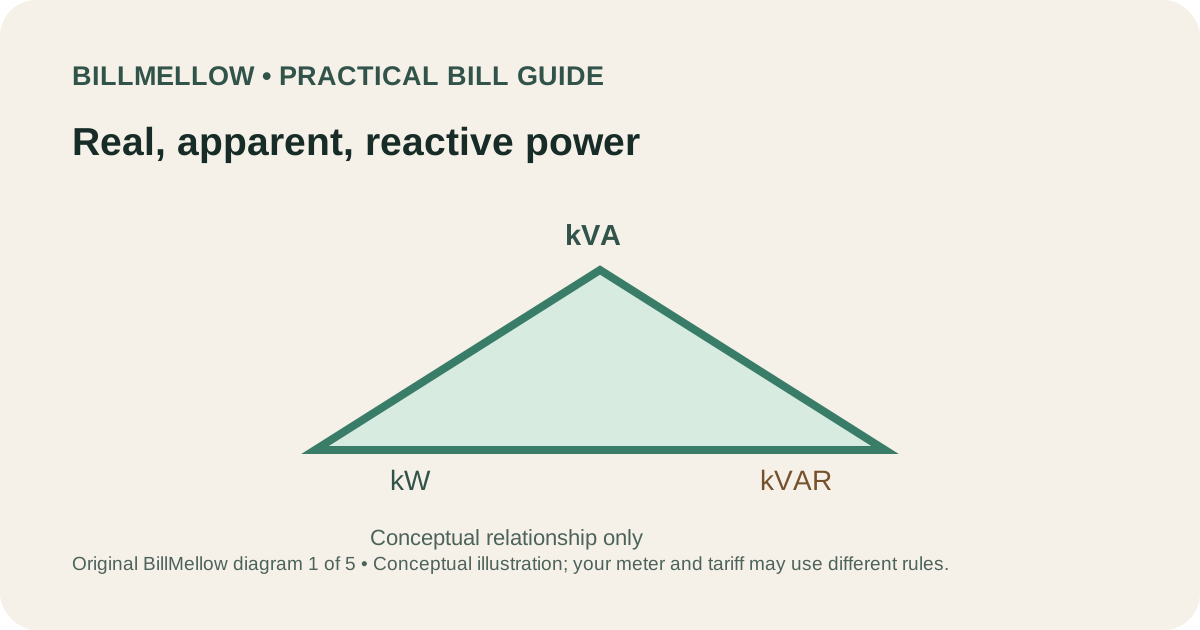
A power factor charge is a rate schedule-specific bill item or adjustment that may relate to how efficiently a facility uses delivered electrical capacity. Power factor compares real power measured in kilowatts (kW) with apparent power measured in kilovolt-amperes (kVA). Some utility rates use a minimum power factor threshold or bill kVA, reactive energy, or adjusted demand; many residential customers will not see a separate power factor line at all.
This subject is most relevant to some commercial, industrial, or larger service accounts with motors, transformers, lighting equipment, or other electrical loads. The precise definitions, threshold, measurement period, and cost formula differ by rate schedule. A low number alone does not tell you that a penalty was charged or that equipment should be changed. Read the specific bill and rate schedule and ask the provider for the calculation.
Real power, apparent power, and reactive power
Real power, commonly expressed in kW, is the part of electric power that performs useful work such as producing light, heat, motion, or computing. Apparent power, often expressed in kVA, describes the combined electrical demand that a supply system must deliver under its measurement convention. Reactive power, often expressed in kVAR, is associated with energy exchanged by electric and magnetic fields in some AC equipment. These terms are related but not interchangeable, and a customer's bill may report only a subset of them.
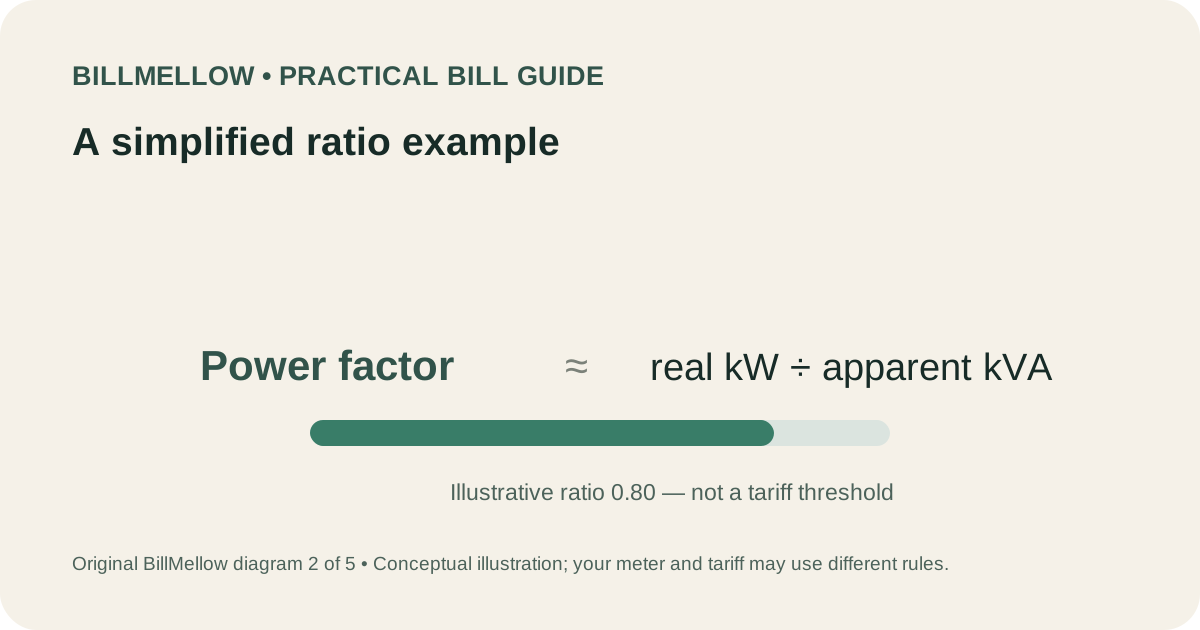
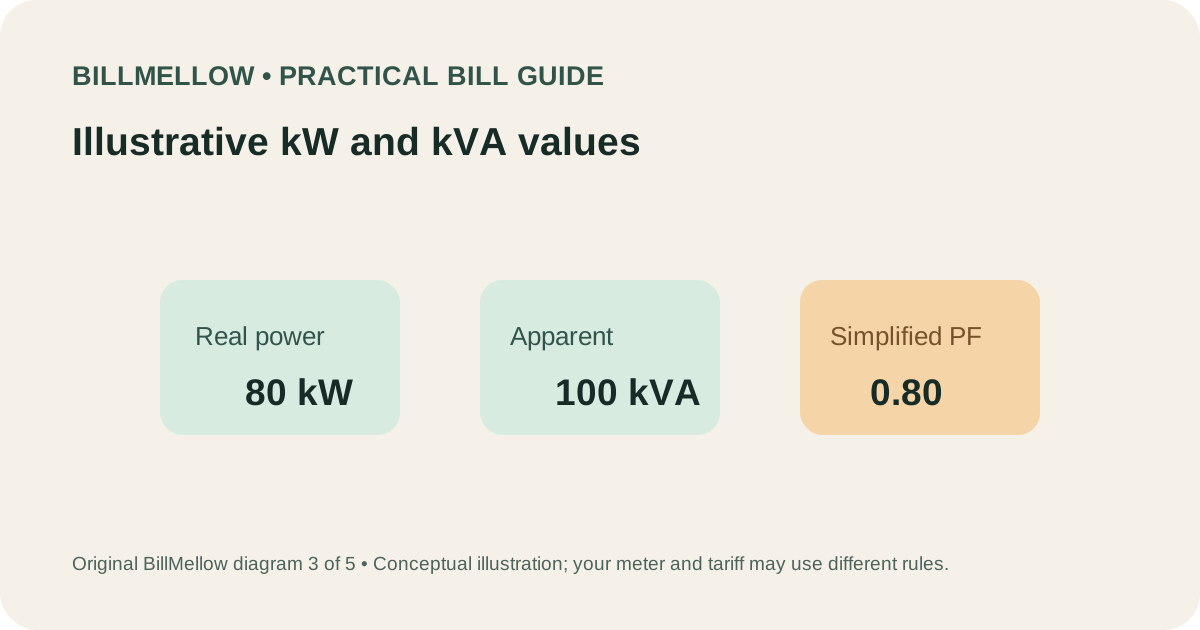
The ratio is often described in simplified form as real power divided by apparent power: kW ÷ kVA. If real power is 80 kW and apparent power is 100 kVA, the ratio is 0.80, or 80 percent, under that simplified representation. Actual utility calculations can use interval measurements, energy registers, leading or lagging values, phase details, or other defined in the rate schedule methods. Do not infer a billable ratio from equipment nameplates or a single instantaneous reading.
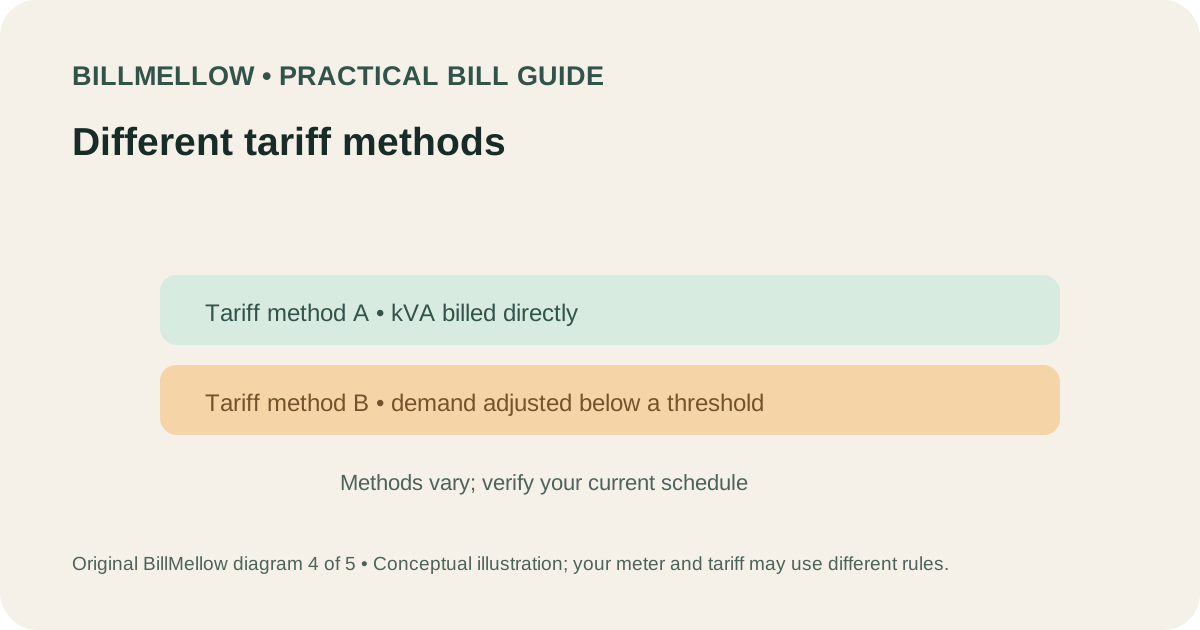
A lower power factor can mean that more apparent capacity is required to deliver a given amount of real power in a facility. Some rate schedules account for this with a kVA demand charge, a minimum power factor rule, a demand adjustment, or a reactive-energy line. Other rates do not add a separate charge. The applicable schedule states which approach applies.
What does a power factor number mean?
A bill may show a value such as 0.92, 92%, or “PF,” but first check the provider's label and calculation notes. A higher ratio is generally closer to one in the basic relationship, yet the rate schedule may define thresholds and treatment in a specific way. Whether a number triggers any charge depends on the rate and measurement interval. A generic threshold found in a different utility's document is not a valid substitute for your own rate schedule.
Some utility schedules adjust demand if the recorded power factor falls below a stated minimum, while others bill apparent demand directly or assess a kVAR-related item. The formula may be applied per interval, to a monthly maximum, or to another defined billing quantity. It may also distinguish lagging and leading conditions. This means two accounts with a similar displayed number can receive different bill treatment because their rates and service classes differ.
Power factor is not the same as an energy efficiency score for a home appliance, nor does a low ratio necessarily mean the equipment wastes an equal percentage of kWh. The bill impact and engineering remedy depend on the electrical system, load pattern, rate schedule, and safety requirements. Technical diagnosis requires appropriate instruments and expertise.
Where the charge may appear
Check the entire statement for labels such as “power factor,” “reactive power,” “kVAR,” “kVA demand,” “adjusted demand,” “PF penalty,” or a cryptic code. A charge may be incorporated into the billed demand rather than shown as a standalone dollar line. It may also be embedded in the distribution or demand calculation. A missing line does not prove that power factor is irrelevant to the rate; a present label does not by itself establish an error.
Identify the customer class, rate code, service voltage if shown, meter number, billing period, billed kW or kVA, power factor value, and any multiplier. Compare the current schedule with the one effective during the bill dates. A rate schedule may have changed, or a utility may revise a rate at an approved effective date. If one account has multiple meters, verify which one the adjustment belongs to.
Separate energy charges from demand and non-energy items. A lower kWh total does not guarantee a lower demand or power factor adjustment. Likewise, an increased all-in cost per kWh can result from fixed or demand components that are divided by fewer kWh. For context, see our guide to demand charges and our explanation of electric bill components.
A practical bill review workflow
- Copy exact labels and units. Record whether the bill states kW, kVA, kVAR, kVARh, a ratio, or an adjusted quantity.
- Match the meter and dates. Note the service identifier and exact billing period. Check if a read is actual, estimated, corrected, or multiplied.
- Find the effective rate schedule. Verify its customer class and date; locate definitions and formulas for PF and reactive power.
- Reproduce only the published arithmetic. Apply the stated rate and billed quantity, while keeping taxes and other line items separate.
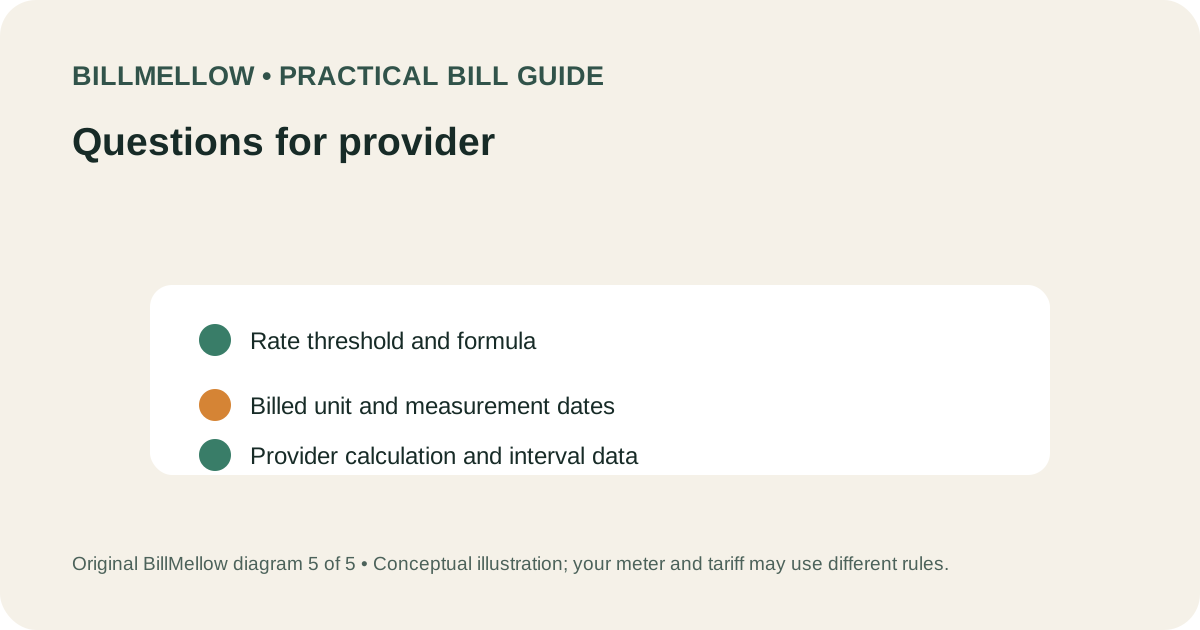
- Request meter or interval detail. Ask how the displayed ratio and billed demand were derived for the relevant period.
- Save the response. Record a case number, review date, and whether a corrected statement will be issued.
Before considering equipment changes
Businesses sometimes evaluate power factor correction equipment, but it should not be treated as a quick consumer purchase based on a bill label. A qualified electrical engineer or contractor should assess the site load, utility requirements, controls, harmonics, protection, equipment compatibility, and the actual cost under the rate schedule. Incorrectly selected capacitors or other equipment can create resonance, overvoltage, equipment damage, or safety hazards. Never open electrical panels or install correction devices yourself.
Ask the utility whether an engineering review, interval data, or a rate comparison is available. DOE materials describe power factor and the possibility of reactive power fees for some commercial accounts, but they do not prescribe a universal fix. Potential bill savings should be modeled using your exact rate schedule and measured load profile, then compared with equipment, installation, maintenance, and operational costs.
Small businesses may have commercial rate schedules even when their premises look like a home, while larger residential services can also have unusual rate arrangements. Do not assume that the same class applies to every account. The utility's service agreement and current rate schedule are the source for classification and billed terms.
Frequently asked questions
Do residential customers pay power factor charges?
Many residential bills do not show a separate power factor line, but service terms vary. Review the residential rate schedule for your provider and service territory rather than applying a commercial example.
Is a 0.90 power factor always a penalty?
No. Thresholds and formulas are rate-specific. A displayed value alone does not say whether the schedule has a threshold or how it calculates any related charge.
Is power factor the same as kWh efficiency?
No. kWh measures energy over time. Power factor relates real power and apparent power in an AC system. They answer different questions.
Can I calculate the charge from the displayed PF?
Usually not from that number alone. You also need the rate schedule's formula, demand or reactive quantity, measurement period, and applicable rate. Ask the provider for a line-by-line calculation.
Sources and limits
The DOE's Understanding Your Utility Bill guide defines power factor as the ratio of real power in kW to apparent power in kVA and explains that some commercial rate schedules adjust demand below a specified threshold. DOE's Energy Data Management Guide glossary notes that some commercial customers may have reactive power fees. These are examples and definitions, not terms applicable to every account.
BillMellow offers educational bill comparisons but has no access to utility interval or account data. See kW vs. kWh and use the private bill comparison tool to organize your own statement values.