UNDERSTAND A kW LINE ITEM
What is a demand charge on an electric bill?
BillMellow Editorial · Updated November 8, 2026
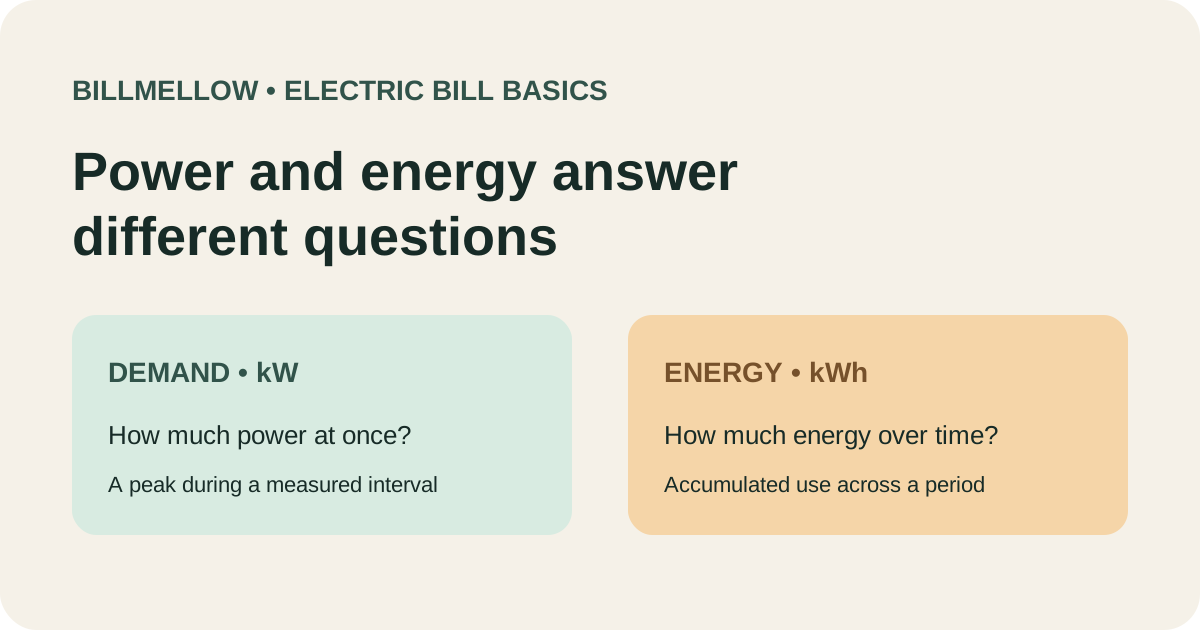
A demand charge is a bill component tied to how much power you draw at once, measured under the rules in a specific electricity rate. It is different from an energy charge, which is usually tied to the total kilowatt-hours (kWh) used over a billing period. A short period of high, simultaneous use can therefore matter even if the monthly kWh total looks ordinary.
This guide explains the terminology, a simple estimate, and the details to look for in a rate schedule. Demand charges do not appear on every electric bill. They are common in many commercial and industrial rate schedules, while residential treatment varies by utility, customer class, metering and jurisdiction. The line on your own bill and the current rate schedule control.
What does a demand charge measure?
Electricity use has two useful dimensions. Energy describes the amount consumed over time; power describes the rate at which electricity is being used at a moment or over a measurement window. A rate schedule may bill a customer for the largest measured demand in a month, for demand during specified hours, or according to another defined method. The unit on the bill may be kW (kilowatts), kVA (kilovolt-amperes), or another quantity specified by the rate schedule.
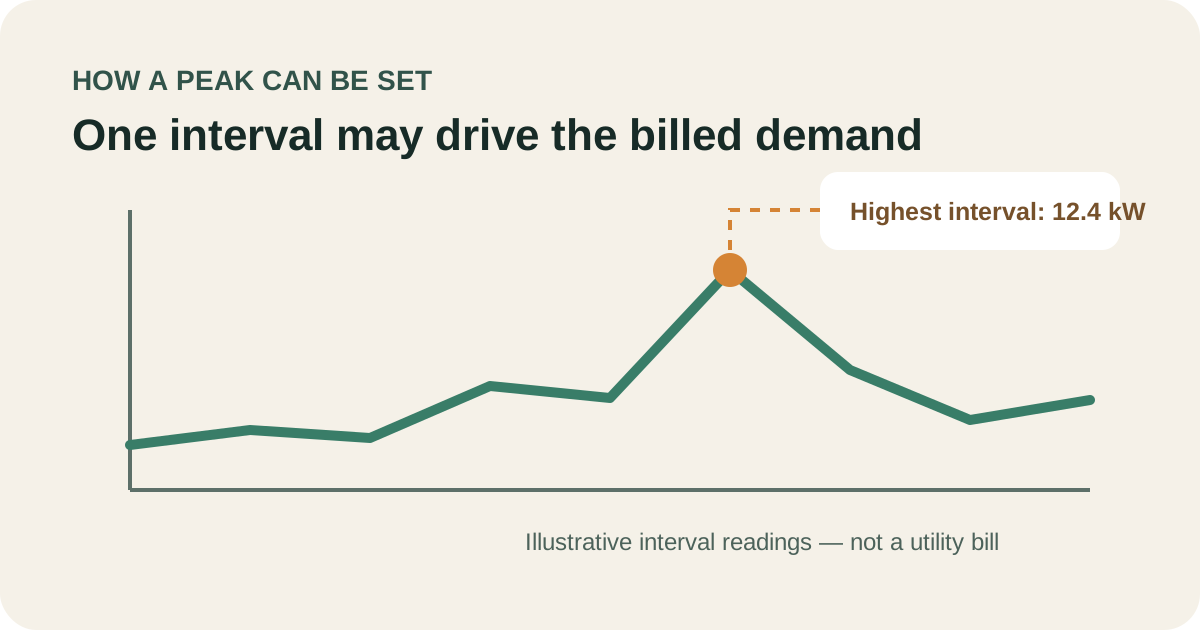
Utilities and grid operators need enough capacity to serve periods when many loads run together. A demand component is one way some rate schedules allocate part of the cost of capacity or delivery. It is not a universal charge or a direct statement that one appliance caused a system problem. A bill alone may show the billed peak without identifying which equipment contributed to it.
Demand in kW versus energy in kWh
One kilowatt is 1,000 watts of power. One kilowatt-hour is the energy used by a 1 kW load operating for one hour. If a 6 kW load runs for half an hour, it uses 3 kWh. If it runs for two hours, it uses 12 kWh. Its power rating did not change, but the accumulated energy did.
For a simple constant load, average power over an interval can be estimated as energy used in that interval divided by interval hours. In practice, a utility meter records and processes readings according to its metering and rate rules. The billing demand may use a 15-, 30-, or 60-minute interval, a rolling window, a time-of-use period, a power-factor adjustment, or other provisions. Do not assume that the highest instantaneous appliance rating equals the billed demand.
Think of kWh as the total water collected in a bucket over a day and kW as the flow rate at a particular time. Two homes can use similar monthly energy but have different peaks if one concentrates high-power equipment in overlapping periods. Conversely, a single high-rated appliance may contribute less than its nameplate rating if it cycles or does not run throughout the whole demand interval.
How to estimate a demand charge
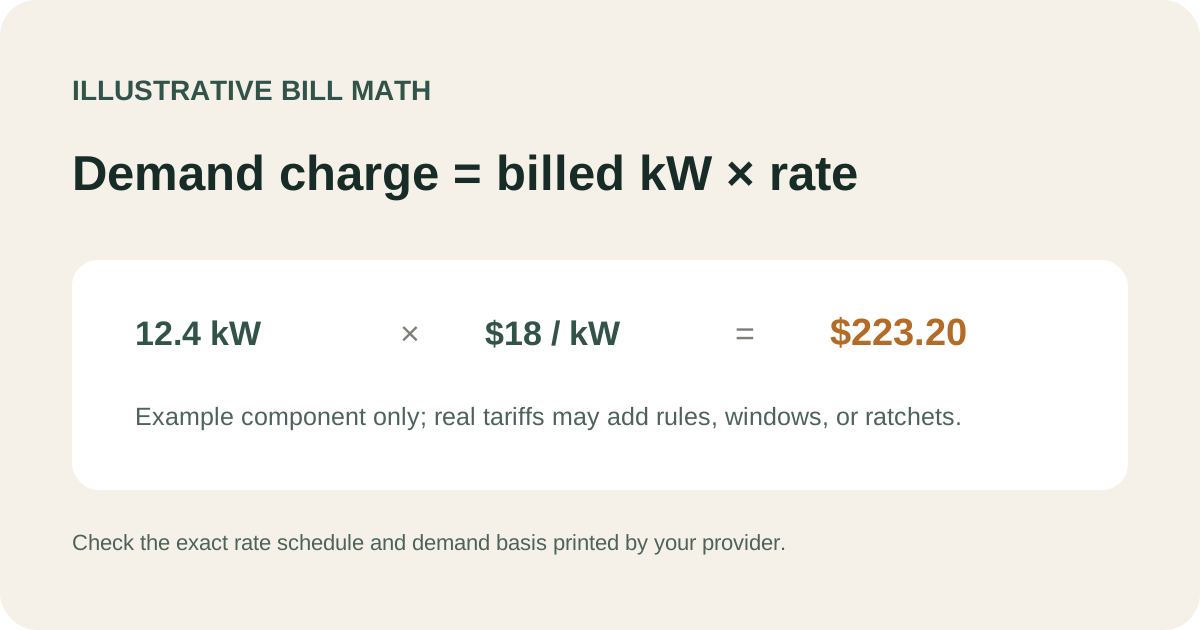
For a straightforward rate schedule, multiply the billed demand in kW by the demand rate per kW:
Demand charge estimate = billed demand (kW) × demand rate ($/kW)
For example, if the bill lists 12.4 kW and the applicable rate schedule lists $18 per kW for that billing period, the simple component is 12.4 × $18 = $223.20. This example illustrates the arithmetic only. It excludes energy charges, fixed customer charges, taxes, riders, minimum bills, tiering, taxes, and rate-specific adjustments. Your actual line can differ if the rate uses a different demand basis, unit, season, period, or calculation.
Do not divide the full bill by monthly kWh and treat the result as a demand rate. That average price combines multiple line items and can move when usage, fixed charges, taxes, credits, or demand charges change. For a broader statement review, see how to read an electric bill and the difference between kW and kWh.
How to read your bill and rate schedule
Start with the exact label and unit. It may say “billing demand,” “maximum demand,” “peak demand,” “non-coincident demand,” “on-peak demand,” or a provider-specific term. Copy the billed quantity, the rate, the dates and any multiplier shown. A demand charge might be listed under delivery rather than supply, and the wording differs by provider.
Then locate the rate schedule that applies to the service address and customer class. Check its effective date and confirm that it applies to the account. Read the definitions and footnotes, not just a summary of prices. In particular, look for:
- Demand interval: the length and method used to calculate each interval reading.
- Billing period: whether the charge uses the maximum for the month or a defined seasonal/time window.
- Demand window: whether only certain hours or days count, and how holidays are treated.
- Measurement basis: whether the rate schedule bills kW, kVA, kVAR, or adjusted demand.
- Ratchet or minimum: whether a previous peak or floor can affect later billed demand.
- Rate units: whether the price is per kW per month, per billing period, or another unit.
- Meter status: whether the usage or demand is actual, estimated, corrected, or associated with a meter change.
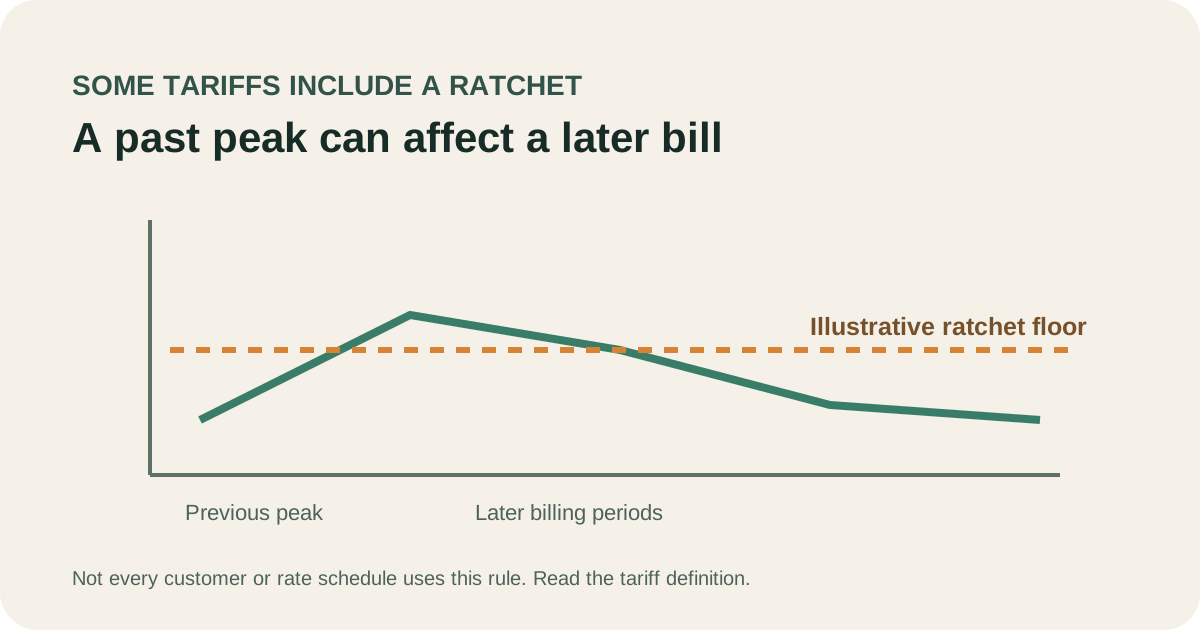
Some commercial schedules use a ratchet: billed demand in a later month may be tied to a percentage of a prior maximum over a stated lookback period. That can make a lower-current-month peak insufficient to reduce the billed kW immediately. A ratchet is not the same as a universal rule, and its exact percentage, time window and exceptions must come from the applicable rate schedule.
How to manage a peak safely
If the rate schedule includes demand charges and you can access interval data, review the date and time of the peak before changing routines or equipment. Compare several billing periods and note whether the peak repeats at a predictable time. A single unusual interval can be worth investigating, but a graph alone does not identify a faulty meter or prove that a particular appliance caused the bill.
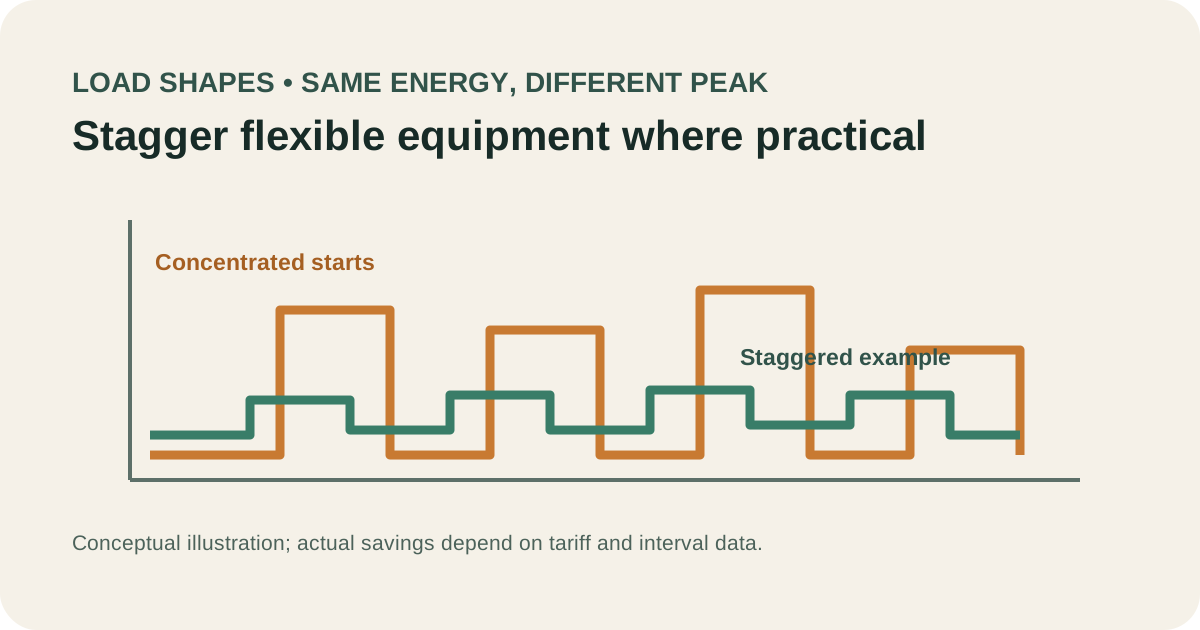
Where practical, staggering flexible high-power loads may reduce overlap. For example, a facility might avoid starting several large motors at the same time, or schedule flexible charging after an operational peak if the rate schedule and charging needs allow it. The potential effect depends on the demand interval, rate window and actual equipment profile. Shifting use can also increase energy charges under a time-of-use plan, so compare the full bill rather than optimizing one line in isolation. See our guide to time-of-use electricity rates.
Do not disable safety, ventilation, refrigeration, medical equipment, process controls, or required building systems to chase a lower peak. Do not open utility equipment or alter wiring. If a change involves motors, HVAC, electrical panels, batteries or charging infrastructure, use a qualified professional and follow equipment instructions, electrical codes and operational requirements. A smaller-looking peak is not worth a safety or reliability problem.
For a business, a qualified energy manager or utility representative may help interpret interval data and the rate schedule. Ask for the interval data in a usable format, clarify whether readings are raw or adjusted, and request the calculation for the billed kW. If your bill is residential and you do not see a demand line, do not assume a separate demand fee applies; check the current residential rate and ask the provider to identify any relevant component.
Questions to ask your utility
- What exact rate schedule and customer class were applied during these service dates?
- Which meter interval, timestamp and value set the billed demand?
- Is the demand actual, estimated, corrected, or adjusted by a multiplier or power factor?
- Does this schedule include a ratchet, minimum, seasonal window, or time-of-use demand rate?
- Can you show how the billed quantity and rate produce this dollar amount?
- Where can I download interval data, and how long is it retained?
- If I believe the meter or calculation is wrong, what review process and deadlines apply?
Use contact information from your official bill or the provider’s verified website. When asking about an account, share account details only through the utility’s secure, official channel. If a line item still looks unexplained, record its label, amount, dates and the provider’s answer. Procedures for formal disputes differ across states and providers.
Frequently asked questions
Is a demand charge the same as a peak-hour energy price?
No. A time-of-use energy charge prices kWh differently across time periods. A demand charge generally uses a measured power quantity such as kW under the rate’s rules. A rate schedule can include both, so inspect each line and definition separately.
Can one appliance cause my whole demand charge?
Not necessarily. The billed peak can reflect several concurrent loads, equipment cycling, the interval definition, and other rate rules. Interval data can narrow down when a peak occurred but may not identify a device without more detailed measurement.
Why is the billed demand higher than the peak I remember?
Possible explanations include an interval average, a time-window rule, a meter multiplier, a power-factor adjustment, a ratchet, an estimated reading, or simply overlapping loads that were not obvious. Ask the utility which calculation was applied; these are possibilities to check, not a diagnosis.
Do all residential customers pay demand charges?
No. Residential rate schedules vary by utility and location. Some use only energy and fixed charges; others may offer or apply demand-based structures to particular customer classes or programs. Check the rate schedule for your own service address instead of generalizing from another bill.
Does reducing kWh always reduce the demand charge?
No. Lower total energy can leave the maximum demand unchanged if the same short peak remains. Conversely, reducing overlap during the relevant interval may affect demand while total kWh changes little. The rate schedule determines which quantity matters.
Sources and editorial limits
The U.S. Department of Energy’s Federal Energy Management Program explains how electricity rate schedules can separate energy and demand components and discusses options such as time-of-use demand and ratchets. The U.S. Energy Information Administration glossary describes demand charges and notes that demand intervals commonly use defined measurement periods. These references explain general concepts; they do not determine the terms for your utility account. The applicable rate schedule and provider’s calculation are authoritative for an individual bill.
Sources: U.S. DOE FEMP: Evaluating Your Utility Rate Options · U.S. EIA: Demand glossary · DOE Better Buildings: Understanding Your Utility Bills — Electricity (PDF)
BillMellow provides educational explanations and user-entered bill comparisons; it is not connected to your utility account and does not verify meter readings or decide whether a rate schedule is valid. Compare two statements with our private bill comparison tool, or use the full electricity guide library.