ELECTRICITY GUIDE
How Much Electricity Does a Well Pump Use?
BillMellow Editorial · Published November 7, 2026 · Updated November 10, 2026

Estimate a private well pump’s electricity cost from measured electrical input and actual run time, while accounting for water demand and billing-rate details.
Estimate an appliance's electricity cost
A private well pump does not run every minute of the day. It switches on when the home uses water and the pressure system calls for more. That makes the nameplate horsepower alone a poor shortcut for a monthly electric bill. A practical estimate needs the pump’s electrical input while running, its accumulated runtime, and the electricity rate on your bill. The most useful check is a safe measurement over a period that reflects ordinary household water use.
The basic calculation
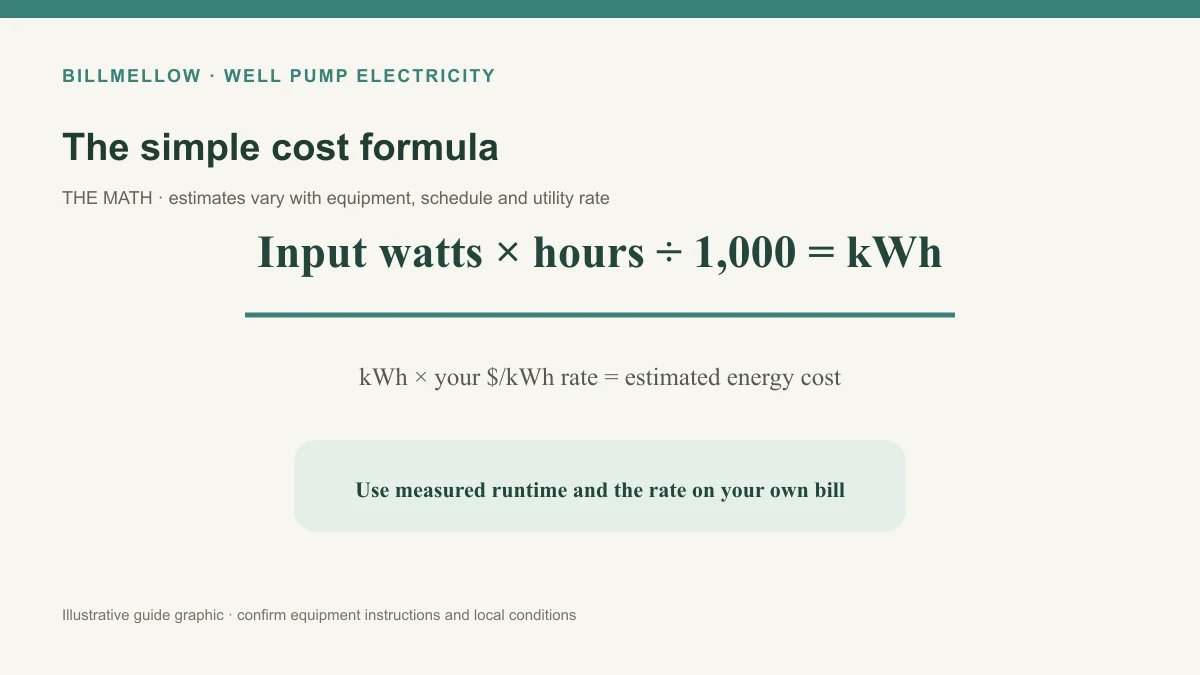
For a steady electrical input, kilowatt-hours equal watts × operating hours ÷ 1,000. Multiply kWh by the marginal price you pay for another kWh to estimate energy cost. If a pump draws 1,000 watts while running and operates for a total of one hour per day, the example is 1 kWh per day or 30 kWh in a 30-day month. At an illustrative $0.18 per kWh, the energy portion is $5.40. This is a scenario to show the math, not a typical well-pump cost. Your pump, well depth, water use, motor loading, pressure setting, and tariff can produce a different result.
Find a useful input value
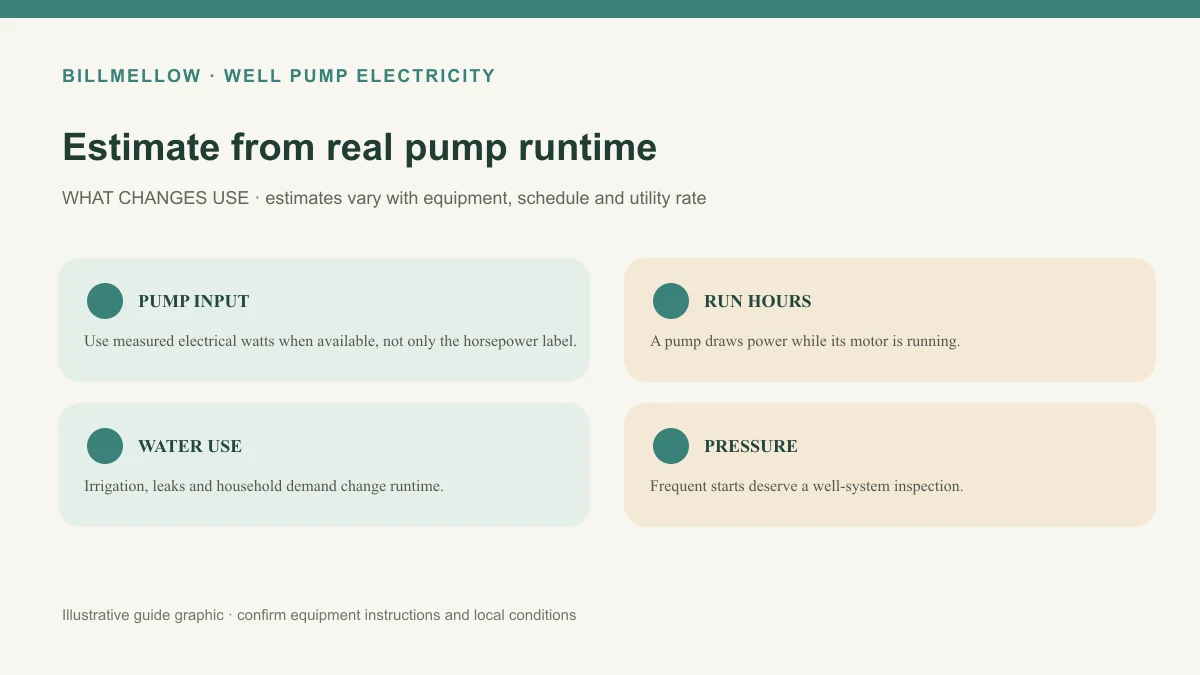
Start with the pump or motor documentation and record the model, voltage, rated current, and horsepower if shown. Horsepower describes mechanical output, not necessarily the electrical watts drawn from the outlet. Motor efficiency and load matter. If the documentation gives electrical input in watts or kW, use that for a first estimate. If it gives only volts and amps, converting to real power can be more complicated for a motor than simply multiplying the two; do not treat that rough product as an exact meter reading.
Do not open an electrical panel, pressure switch, well cap, or pump wiring to obtain a measurement. If the pump is hardwired, ask a licensed electrician or qualified well contractor about a safe circuit-level measurement. A whole-home monitor can show changes in household use, but it cannot prove the pump caused them unless the measurement isolates the pump. Record utility meter readings over a period when other household loads are reasonably similar.
Runtime changes with water demand
The pump’s energy use rises when it runs longer. Irrigation, filling a pool, guests, laundry, a water softener regeneration cycle, and leaks can all change how much water moves through the system. A dry spell may increase outdoor watering; a leaking toilet may add pump cycles without an obvious change in normal routines. Use a separate water meter or the utility’s well-system data if available to compare gallons with electricity, but remember that different fixtures and irrigation schedules change pressure demand.
The pressure tank and controls affect how often a pump starts. Frequent short cycling can signal a system issue, such as a pressure tank problem, a leak, a control fault, or another condition that needs diagnosis. It is not a reason to change pressure settings yourself. If you hear rapid repeated starts, notice pressure fluctuations, or the pump runs when no water is being used, note the time and call a qualified well professional. A pressure system should be evaluated as a whole; replacing a pump based on an electricity estimate alone can miss the underlying cause.
A simple way to measure and compare
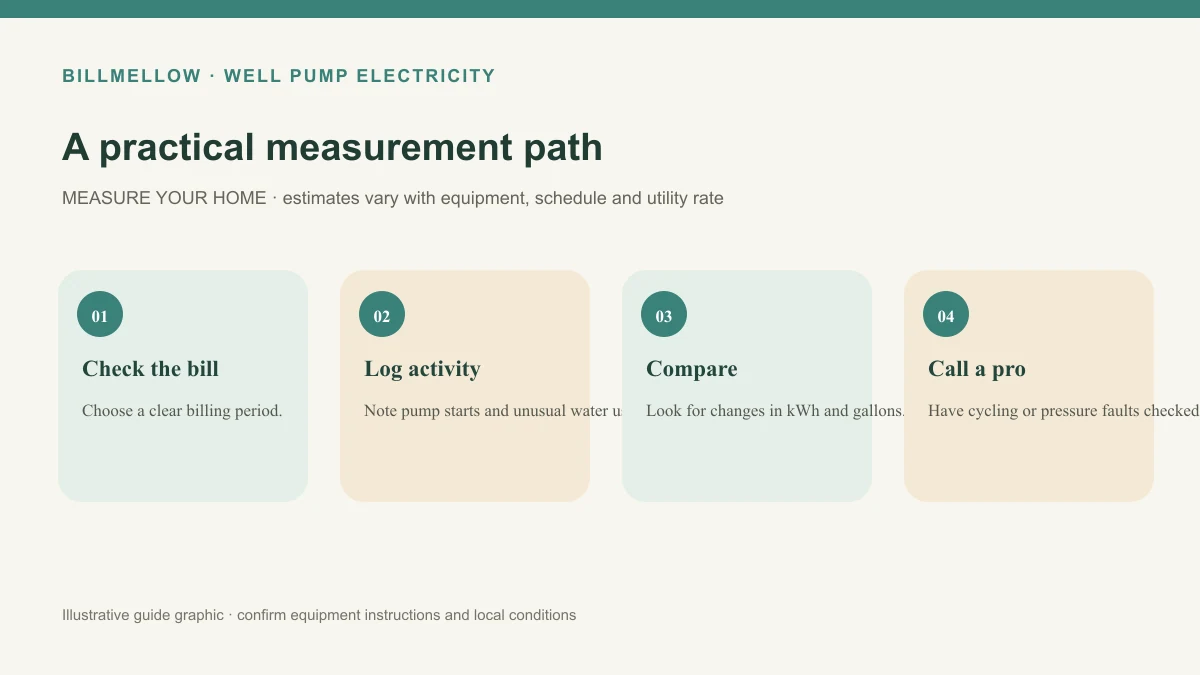
Choose a 7- to 14-day period that includes normal indoor use and any scheduled outdoor watering. Read the utility meter or energy monitor at the same time each day. Note unusual events: guests, irrigation, a power outage, water treatment cycles, or a suspected leak. If you can obtain a safe dedicated pump reading, compare daily kWh with the log. Without a dedicated reading, compare the same days of the week across similar periods and regard the difference as a clue, not proof.
For a more reliable energy value, a qualified contractor can measure the pump circuit while it is operating and explain the equipment’s electrical input. Do not infer runtime from the sound of the pump alone when the system is in a different building or when controls are inaccessible. A circuit monitor also needs to match the pump’s voltage and installation. Safety comes before a more precise number.
Estimate the bill portion
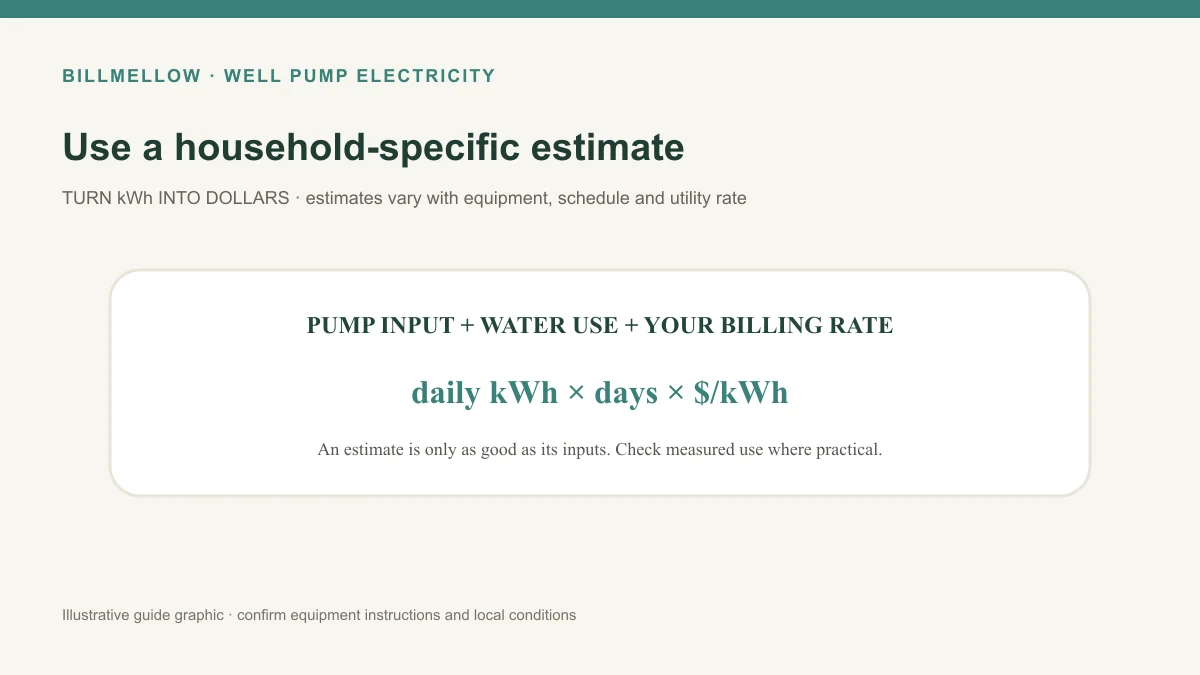
If a monitor shows 14 kWh for the pump over seven ordinary days, a rough monthly projection is 14 ÷ 7 × 30 = 60 kWh. At an illustrative marginal rate of $0.18 per kWh, that is $10.80 in variable energy charges. The projection assumes the month resembles the sample week; outdoor water use, drought restrictions, guests, and seasonal tasks can make that assumption wrong. Use multiple weeks if your water pattern changes from week to week.
The price per kWh should come from the part of your bill that changes with energy use. Delivery riders, time-of-use periods, demand charges, taxes, or tiered pricing can affect the actual cost. Dividing the total bill by total kWh mixes fixed charges into an average and may not match what another kWh costs. BillMellow’s electric bill guide explains how to separate charges, and the bill comparison tool can help compare billing periods.
What a higher reading can and cannot tell you
A rise in household kWh is a reason to investigate, not proof that the well pump is failing. Compare billing days first, then look at water use, irrigation, pressure behavior, and other large electric loads. If the pump runs much longer than before, cycles rapidly, loses prime, trips a breaker, or water pressure changes suddenly, contact a licensed well contractor. For electrical smells, damaged wiring, or repeated breaker trips, keep clear and contact a qualified electrician.
The Department of Energy’s research on pump and fan systems discusses how residential pumps are used and why equipment and runtime vary. Its report contains older national estimates, so those values should not be read as a current household benchmark. This guide uses your own measured input and schedule instead. The result estimates electricity cost; it does not diagnose a well, motor, pressure tank, or water-supply problem.
All electricity guides · Compare plan costs · Methods and limits · Editorial standards