ELECTRICITY GUIDE
Turkey Roaster vs. Electric Oven: Which Uses Less Electricity?
BillMellow Editorial · Published November 15, 2026
Compare a countertop turkey roaster with an electric oven using actual input watts, preheat time, cooking duration, food quantity, and your local electricity rate.
Estimate an appliance's electricity cost
Compare the same cooking job
A fair energy comparison holds the food, target doneness, cooking temperature, room conditions and timing as close as possible. A compact roaster and a full-size oven are different appliances, but a lower watt rating alone does not prove that the total cooking session uses less energy. One unit may preheat differently, cycle differently or take longer. Record the exact model, amount of food, total elapsed time and relevant settings.
Electric turkey roasters can be useful as a second cooking appliance during a busy meal. This guide estimates electricity; it does not recommend a cooking method or replace food-safety guidance. Follow the appliance manual and authoritative food-safety instructions for safe handling and internal temperature. Never leave cooking equipment unattended when its manufacturer says otherwise.
Read the input rating for each appliance
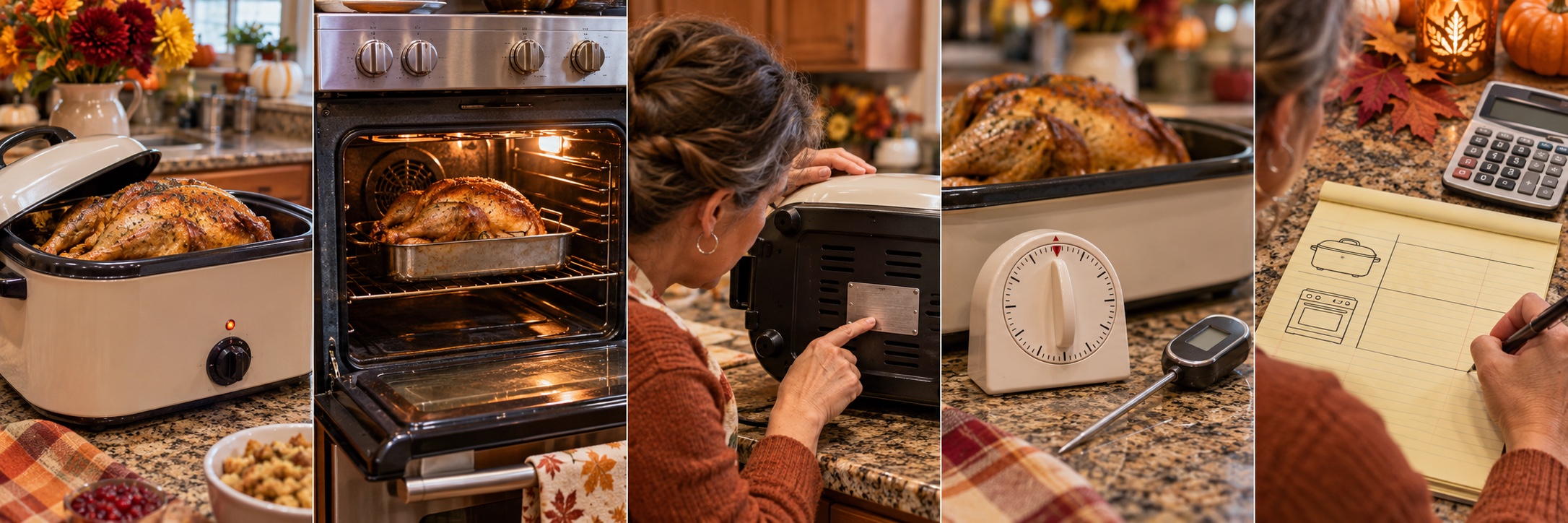
Look at the roaster’s nameplate or manual for watts and voltage. For a built-in oven, use the rating plate or manual; a range may list the combined rating for multiple elements, so do not assume every component runs at once. A conventional oven thermostat cycles elements to maintain temperature. A roaster may also cycle its element. The full wattage multiplied by the entire cooking time is a maximum-style estimate, not necessarily measured consumption.
For a 1,500-watt hypothetical countertop appliance operating at an equivalent full-power runtime of 2.5 hours, use would be 1.5 × 2.5 = 3.75 kWh. At an illustrative 18 cents per kWh, the energy portion is about $0.68. If an oven’s actual measured use for the same job were 5 kWh, it would cost $0.90 at the same example rate. Those values illustrate arithmetic only; they are not average figures for turkey roasters or ovens.
Include preheat and cycling
Record the time to preheat, how often the thermostat cycles if measurable, and the time the appliance remains hot after the food is removed. A warm-up indicator may show that the target temperature has been reached, but it is not a measurement of kWh. A plug-in energy meter may be appropriate for some countertop appliances only if it is rated for the appliance load and permitted by the manuals. Never put a meter on a range circuit or modify a high-voltage connection as a DIY project.
For a household comparison, use a dedicated, properly rated meter or manufacturer documentation. A qualified electrician can advise on safe measurement of a hardwired oven. Do not use a smart plug intended for small loads with a high-wattage cooker. Keep cords, hot surfaces and appliance clearances in line with the instructions.
Translate the results to your tariff
Multiply session kWh by the price that applies at the time of cooking. If dinner is prepared during a peak price window, the two appliances should be compared using the same period. Delivery charges may have variable portions; taxes and fixed fees may not change with one cooking session. If your tariff is time-varying, calculate each period separately instead of multiplying by the year’s average price.
A monthly electric bill divided by all household kWh is not always the right marginal rate for an additional appliance. Check the bill or tariff for the energy charge, per-kWh delivery charges, peak windows and applicable riders. The result is the estimated electricity portion of one cooking event, not a complete bill or product cost comparison.
Do not trade away food safety for a lower estimate
Use only an appliance intended for the food and quantity you are preparing. Follow the cooking directions and use a clean food thermometer where appropriate. The U.S. Department of Agriculture’s turkey guidance should be used for safe handling and verified internal temperature; appliance wattage does not determine whether food is safe. Do not select a cooking time based only on an energy-cost example.
Keep the roaster on a stable, heat-resistant surface with the clearances specified by the maker. Keep children away from hot exterior surfaces, steam and cords. Avoid using damaged cords or outlets, and do not plug multiple heat-producing appliances into an overloaded connection. Stay in the kitchen when required by the appliance’s instructions and safe cooking practice.
Think about kitchen heat and ventilation
A full-size oven can release more heat into a kitchen than a smaller countertop appliance, but the room-temperature effect varies with insulation, cooking duration, ventilation and weather. In cold weather, some heat may remain in the home; in warm weather it may add to cooling demand. This does not make either choice universally cheaper. Measure the actual electricity use and consider comfort separately.
If you cook several dishes, look at the whole meal schedule. Running an oven, roaster and other appliances at the same time can increase coincident electrical demand even when the event’s total kWh is moderate. Follow circuit limits and appliance instructions. If breakers trip, an outlet is hot or you smell burning insulation, stop using the affected device and arrange qualified electrical help.
A reusable comparison worksheet
For each appliance, write down: model and rated input; food type and quantity; temperature setting; preheat minutes; total cook time; any measured kWh; utility rate and time window; and other charges excluded. Compare the actual session with the same assumptions. If only the nameplate is available, show a range or clearly label the full-power upper estimate. Do not present an assumption as a measured result.
If the roaster and oven produce different cook times or portions, report that limitation. You can calculate cost per session, but the value judgment also includes appliance purchase price, counter space, convenience, cleanup, cooking quality and the possibility of needing both devices. A small cost difference should not be overstated as a guaranteed household saving.
Does a turkey roaster always use less electricity than an oven?
No. It depends on each product’s rated watts, thermostat cycling, preheat time, cook time and amount of food. Compare actual kWh for the same cooking task rather than comparing watt labels alone.
Can I multiply oven watts by the entire cooking time?
That gives a maximum-style estimate if the element runs continuously. Ovens cycle to regulate temperature, so measured consumption or manufacturer data is more representative. Do not open a hardwired oven to measure it.
Is a plug-in meter safe for a roaster?
Only if its voltage and current rating exceed the device requirements and the appliance instructions allow it. Do not use a small smart plug for a high-power cooker.
Can the lower-cost option cook a turkey safely?
Energy cost does not determine food safety. Use the appliance manual and USDA turkey handling and temperature guidance.
Does the estimate include delivery fees and taxes?
Only if you intentionally include applicable variable charges. The simple rate multiplication estimates energy cost; the full bill includes other charges.
All electricity guides · Compare plan costs · Methods and limits · Editorial standards