ELECTRICITY GUIDE
Home Battery Backup Runtime: Estimate What Will Stay On
BillMellow Editorial · Published November 12, 2026
Estimate how long a home battery may power selected circuits during an outage by checking usable capacity, load, reserve settings, and manufacturer limits.
A home battery’s advertised capacity does not tell you exactly how long your lights, refrigerator, internet, or heating system will run in an outage. Runtime depends on usable energy, the loads connected, starting surges, conversion losses, temperature, reserve settings, and the equipment’s operating limits. The best first step is to identify which circuits the system can actually serve. Then use the manufacturer’s specifications and a realistic load list to estimate a range—not a promise.
Start with usable energy, not the headline number
Battery capacity is usually expressed in kilowatt-hours (kWh), while power output is expressed in kilowatts (kW). Capacity describes stored energy; output describes how much power can be delivered at a moment. A system can have plenty of energy but still be unable to start a large motor if its power or surge rating is too low. Ask for the usable capacity under the conditions relevant to your system, the continuous output limit, and the permitted surge duration. Confirm whether the quoted capacity is DC-side or AC-deliverable energy.
Build an essential-load list
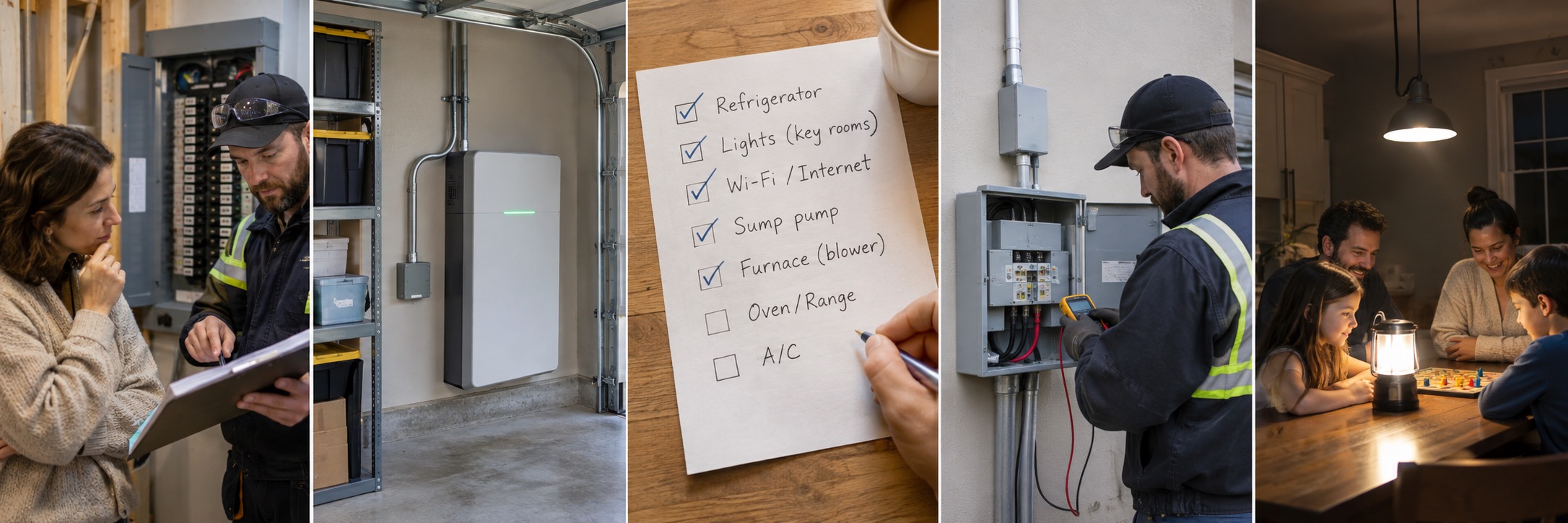
List the devices or backed-up circuits you care about: refrigerator, lights, internet router, phone chargers, sump pump, well pump, medical equipment, or a small portion of heating and cooling. Use the manufacturer label or a plug-in meter where safe and appropriate to estimate watts. For hardwired equipment, have a qualified electrician measure or identify its load. Record whether a device runs continuously or cycles. Do not treat a nameplate’s maximum input as the average draw, but do not use a low average to ignore startup surges or safety-critical loads.
Use a first-pass runtime formula carefully
A rough estimate is usable battery energy in kWh divided by average load in kW. For example, if the manufacturer says 10 kWh is usable and a selected group of loads averages 0.5 kW, the arithmetic gives 20 hours before other limits. That is not a guaranteed runtime. Inverter losses, reserve settings, actual cycling, battery temperature, aging, and high-power starts can shorten it. Include only loads the system is configured to serve. Verify how the system handles a load above its output rating and what happens when the battery reaches its reserve threshold.
Understand transfer and backed-up circuits
Some systems back up a dedicated group of circuits; others may support more of a home through approved equipment. The panel labels alone do not prove which circuits will remain energized. Ask the installer for a written one-line diagram or a clear circuit list, and confirm which loads are intentionally excluded. High-demand appliances such as electric ranges, dryers, water heaters, HVAC equipment, and EV chargers may consume energy quickly or exceed the output capacity. Do not reconfigure the panel or move breakers yourself.
Check reserve, solar, and outage behavior
A battery may hold a reserve for outages, follow a daily self-consumption schedule, or participate in a utility program. Review what happens when an outage begins: does the system switch automatically, is there a short interruption, and can solar recharge it while the grid is down? Some grid-connected solar systems stop producing during an outage unless they are designed and configured for islanded operation with compatible storage equipment. Ask the installer and manufacturer to confirm the exact behavior of your model. Do not assume panels will provide power just because sunlight is available.
Compare runtime scenarios
Create at least three scenarios: essentials only, essentials plus a heating or cooling load, and normal household use. For each, list the backed-up devices, average operating pattern, and any large startup demand. Use the product’s monitoring data when available, but remember one day of normal use may not match a storm outage. If family members will change how equipment is used, document that in the plan. A range such as “about 12 to 18 hours under this load list” is more honest than a single precise number based on unknown conditions.
Questions for an installer
Ask for usable capacity, continuous and surge output, battery reserve behavior, cold- or hot-weather limits, the backed-up-circuit list, equipment maintenance, warranty terms, and the process for testing the system safely. Ask whether the quoted design includes the permits and inspections required locally. Request a demonstration of the transfer behavior and emergency shutdown. Confirm who to contact if the system displays a fault during an outage. Keep the operating manual, system diagram, and commissioning records where household members can find them.
Keep the decision grounded in your own home
Runtime depends on usable battery energy, inverter output, the loads that run at the same time, reserve settings, temperature, and conversion losses. Use the battery maker’s usable-capacity figures and actual device input where available. An online estimate cannot confirm the installed system’s condition or guarantee outage duration.
Separate facts from assumptions
Write down usable kilowatt-hours, continuous and surge output, the backup reserve, and the wattage or measured energy of each essential load. Treat nameplate estimates and a device’s average use as assumptions until checked against actual operating patterns. Ask the installer how the system behaves during an outage.
A practical record to keep
Keep the system manual, commissioning and warranty papers, battery model and usable capacity, reserve setting, backed-up circuit list, installer contact, and any utility interconnection records. Note which loads are intentionally excluded. Review the settings after adding major equipment or enrolling in a grid program.
Common mistakes to avoid
Do not divide battery capacity by a single appliance rating and present the result as guaranteed runtime for a whole home. Do not forget simultaneous loads, startup demand, reserve limits, or system losses. Avoid changing wiring or opening battery equipment; use the installer for configuration and safety questions.
A short next-step checklist
- Confirm usable battery capacity and inverter power in the manual.
- List backed-up circuits and measure or verify each load.
- Decide which loads are essential and which can be switched off.
- Include the configured reserve and operating losses in an estimate.
- Ask the installer to verify the plan for your specific system.
Frequently asked questions
How do I estimate battery runtime?
Divide usable battery energy by the combined average load, then allow for system losses, reserve settings, changing loads, and temperature. Treat the result as an estimate and check it with the installer.
Will a home battery run the entire house?
Not necessarily. Inverter limits, backed-up circuits, battery capacity, and simultaneous appliance demand determine what can operate. Check the system’s documented configuration.
Does the backup reserve reduce available runtime?
Yes. Energy held in reserve for other purposes is not available to the loads in your estimate. Review current settings and any grid-program terms.
Sources and scope
This article is general U.S. consumer education, not an electrical design, legal opinion, emergency dispatch service, or utility quote. Read the primary-source material linked in the relevant section and confirm local requirements before acting. Official guidance can change; check the publication and revision dates on the source page.
Primary source: U.S. Department of Energy grid modernization and storage information and the storage system manufacturer’s current installation and operating manuals.
All electricity guides · Compare plan costs · Methods and limits · Editorial standards