ELECTRICITY GUIDE
Heat Tape Electricity Cost: Estimate Use and Check Safety
BillMellow Editorial · Published November 15, 2026
Estimate pipe heat cable electricity use from watts per foot, cable length, thermostat runtime, and your rate. Review CPSC safety guidance before using heat tape.
Estimate an appliance's electricity cost
What heat tape does—and what it does not do
Electric heat tape or pipe-heating cable is intended to help protect compatible pipes from freezing under specified conditions. It does not repair a leak, replace insulation design, or make every exposed pipe safe in every storm. Products differ by pipe material, pipe size, location, wattage, thermostat, installation method and whether the cable is self-regulating. Read the exact model instructions and label before estimating energy use or planning an installation.
Do not substitute a cable intended for water pipes onto a roof, gutter, driveway, fuel line or another application. CPSC’s older heat-tape safety guidance specifically says products should be used for the application and pipe for which they are rated. When in doubt about the cable, installation, wiring or local code, contact a qualified electrician or plumber. This article is for estimating use, not a wiring or installation procedure.
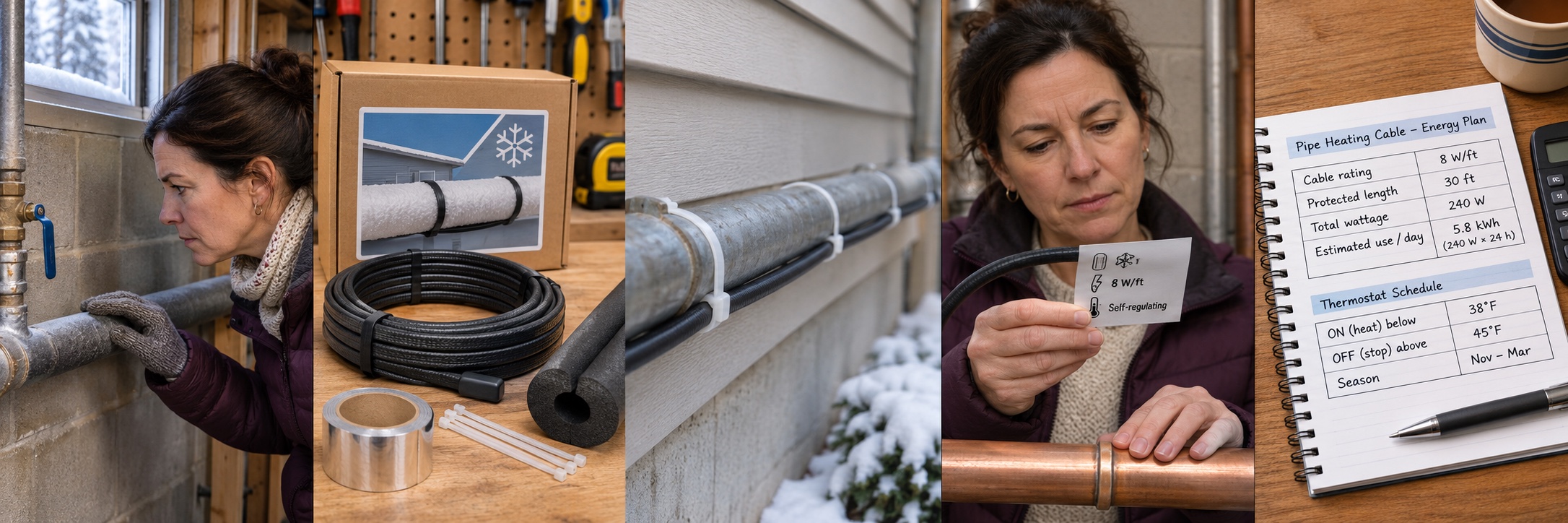
Read total input power for the installed cable
A package may list watts per foot, total watts, a voltage, or a range based on temperature. Use the product’s own input information. If watts per foot are listed, multiply by the installed length to estimate the connected load. If the manufacturer supplies a total-wattage table for a specific pipe and installation condition, use that table instead. Do not infer watts from the cable color or appearance.
If the thermostat switches the cable on and off, actual energy use depends on the number of hours the heating element is energized. A self-regulating cable may change power along its length and as its environment changes. A single nameplate maximum can therefore be a conservative upper estimate rather than a measure of average use. Use a manufacturer’s consumption guidance or a safely rated meter installed by someone qualified if you need an actual measurement.
A rough example: 20 feet of cable rated at 5 watts per foot would have 100 watts of nominal connected load. If it were energized for an equivalent 8 hours each day over 14 days, the example would be 0.1 kW × 8 × 14 = 11.2 kWh. At 18 cents per kWh, that is about $2.02 in energy charges. Real cable ratings and runtimes differ; replace every assumption with the product details.
Model thermostat runtime as a range
A thermostat can control runtime, but outdoor temperature, wind exposure, pipe temperature, insulation, thermostat placement and settings all affect how often it calls for heat. If the package gives a minimum and maximum watt draw, calculate both. If you have no runtime data, make a low and high scenario rather than presenting one number as certain. The maximum case can assume the full rated load operates continuously for the period; a more typical case should only be used if you have reliable manufacturer data or measured usage.
Keep the calculation transparent: cable length, listed watts, voltage, days, equivalent full-power hours and rate. For time-of-use plans, calculate separately for the tariff periods. If the thermostat has a specific operating instruction, do not change it to chase a lower estimate. Freeze protection and product safety come first.
Installation details affect safety and consumption
Heat tape is not a universal do-it-yourself product. CPSC warns consumers to follow the product instructions and avoid wrapping a cable over itself unless specifically allowed. Whether the thermostat should contact the pipe or remain exposed depends on the exact instructions. CPSC also advises that end caps be sealed and kept out of standing water, and that tape be inspected for damaged insulation, discoloration, charring, cuts or bare conductors. Follow current manufacturer instructions and local codes; older general guidance cannot replace the instructions for a specific modern product.
Some products permit insulation over the cable and some specify restrictions. Never bury, overlap or cover a cable based on a guess. The pipe material, cable listing, insulation, environment and overcurrent protection all matter. If you find scorch marks, a hot plug, cracked insulation or exposed wire, disconnect only if you can do so safely and have a qualified professional inspect or replace the assembly. Do not energize damaged equipment to test whether it still works.
Compare energy cost with pipe protection choices
The electricity estimate is only one piece of winterization. Insulation, sealing drafts, relocating vulnerable plumbing, draining a line where appropriate and having a plumber evaluate a recurring freeze may be alternatives or complements depending on the building. Do not block required vents or create a fire hazard by improvising around pipes. A heat cable’s small energy cost, if it is small in your calculation, does not prove the installation is safe or the best solution.
If the system runs unexpectedly often, inspect visible thermostat location and insulation only in ways permitted by the product instructions. A cable that is too short, poorly positioned or unsuitable may not protect the full run. Ask a plumber to review the pipe and a qualified electrician to check electrical supply concerns. For rental housing, contact the property manager before modifying the plumbing or wiring.
Read the bill after a cold snap
Compare the affected billing period with a similar one: number of days, daily kWh, weather and occupancy. A higher total can reflect longer billing days, space heating, water heating, a price change, an estimated read or several things at once. A bill rarely identifies a heat cable as the cause by itself. If the energy model predicts 11.2 kWh but household usage rose by hundreds, investigate the rest of the home rather than stretching the cable estimate to explain it.
For an account with interval data, compare the periods when the cable would be operating with outdoor temperatures and known thermostat schedules. Do not publish private meter data or a bill with account identifiers when asking a public forum for help. Use the provider’s secure account channel for billing questions and retain the exact service dates, meter-read type and relevant line items.
A safe estimate checklist
Before sharing a cost figure, verify the cable model, rated length, total watts, thermostat behavior, compatible pipe and insulation instructions. State the operating period and the rate used. Identify the result as a modeled energy estimate, not a utility quote, safety inspection or guarantee against freezing. If a factor is unknown, give a range and label the assumption.
This approach keeps the calculation useful without overstating precision. The energy math can be simple; the product and installation rules are not. Use manufacturer documentation, qualified tradespeople and applicable local requirements to decide what is safe for a real pipe run.
How much electricity does heat tape use per foot?
There is no single wattage for every cable. Read the exact model’s watts per foot or total input table; ratings may depend on cable length, pipe material, temperature and installation. Multiply only the specified load by the estimated energized hours.
Can I wrap heat tape over itself?
Only if the specific product instructions expressly allow it. CPSC’s heat-tape guidance warns against overlapping unless the manufacturer permits it. Do not infer that a cable can cross or overlap from its appearance.
Can insulation go over heat tape?
Follow the current manufacturer instructions for the specific product. Some combinations or coverings may be restricted. Incorrect insulation or thermostat placement can create overheating or fire risk. Ask a qualified electrician or plumber if the instructions are unclear.
How do I know if the cable is damaged?
Look for conditions identified in the manual and CPSC guidance, such as cracked or cut insulation, discoloration, charring, exposed conductor or damage at the plug. Do not energize damaged cable; arrange qualified inspection and replacement.
Does a low estimated bill mean the setup is safe?
No. Cost math says nothing about listing, electrical condition, water exposure, clearances or code compliance. Safety depends on proper product selection and installation.
Sources and limits
This estimate depends on the exact cable, thermostat behavior, and operating conditions. The CPSC's heat-tape safety guidance is an older general alert: current product instructions and applicable code take precedence, especially for cable placement, insulation, and thermostat coverage. Check current CPSC recalls and product safety warnings for your model. Cost arithmetic cannot determine whether a particular installation is safe.
Keep a record through the season
Use the private monthly bill tracker to compare statements across cold-weather periods, and the appliance electricity guide for the watts-to-kWh calculation limits.
All electricity guides · Compare plan costs · Methods and limits · Editorial standards