ELECTRICITY GUIDE
Electric Towel Warmer Cost: How Much Power Does It Use?
BillMellow Editorial · Published November 15, 2026
Estimate towel warmer electricity cost from the appliance’s watt rating, warm-up schedule, thermostat cycle, and local rate. Check whether your model is plug-in or hardwired.
Estimate an appliance's electricity cost
Identify the warmer type and its rating
Electric towel warmers include plug-in racks, hardwired ladders, wall-mounted models and compact bars. Their rated watts and control systems differ. Start with the model number and manual, then find the input wattage and whether that figure applies to the whole unit or a single heating element. Do not estimate from the number of bars or the size of the towel.
Some products warm continuously at a fixed output; others include a timer, thermostat, boost function or automatic shutoff. A plug-in model and a hardwired model may require different installation and measurement methods. Follow the exact installation instructions and local electrical requirements. Have a qualified electrician handle wiring, circuit changes, bathroom-zone placement and any code questions.
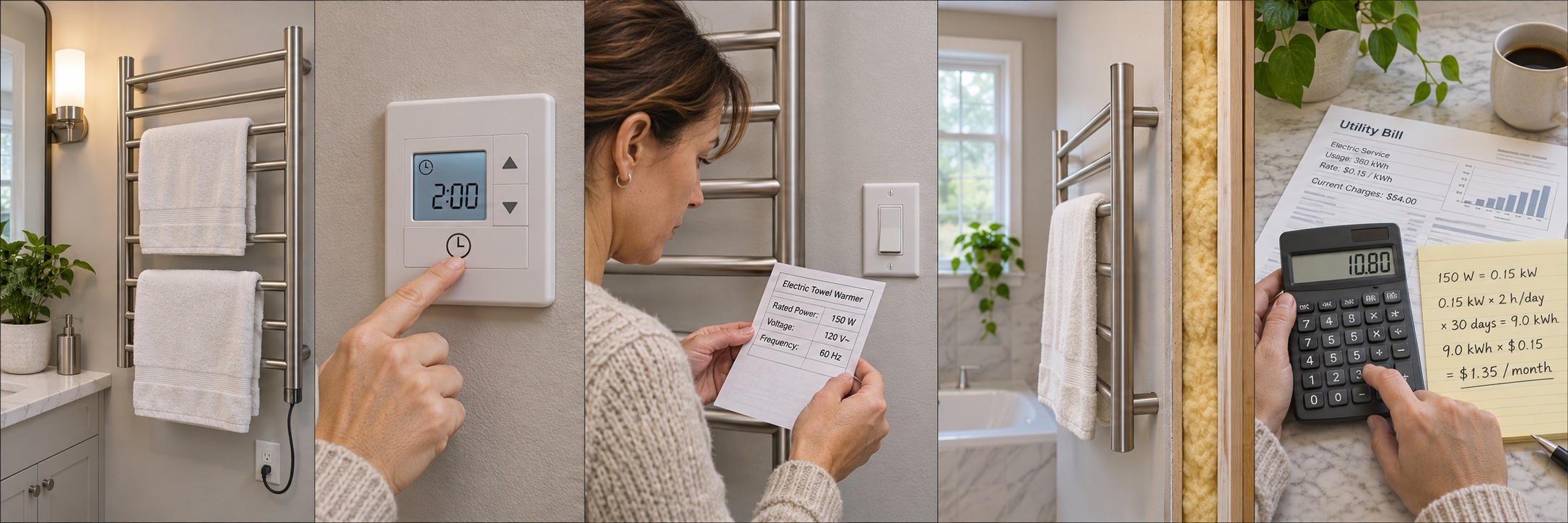
Estimate one warm-up session
The basic formula is rated watts divided by 1,000, multiplied by the number of equivalent full-power hours. A hypothetical 100-watt warmer running at full input for two hours would use 0.2 kWh. At an example $0.18 per kWh, that is about 3.6 cents in energy charges. If it ran those two hours daily for 30 days, the example would be 6 kWh and $1.08. Those numbers are examples only; substitute the model rating, time and price from your situation.
If a thermostat cycles, the actual energy use may be below the continuous full-power estimate. If the manual lists an automatic boost, use the time spent in that mode separately. For a hardwired unit, do not open the wiring enclosure or use a DIY meter. Use manufacturer data or ask an electrician about an appropriate measurement. For a plug-in unit, only use a meter approved for its voltage and current and follow both product instructions.
A timer changes hours, not the appliance rating
A scheduled warm-up before a shower differs from leaving a warmer on all day. List the weekday and weekend schedules separately if they differ. Count the hours that the heating elements are energized, not the time you merely expect to use a towel. If a timer has a standby display, its small standby draw may exist, but measure or use the documented rating rather than assuming zero or adding an arbitrary amount.
A timer can improve convenience and reduce unnecessary runtime, but it must be compatible with the warmer and rated for the load and location. A smart home plug is not automatically suitable for a bathroom or hardwired heater. Keep electrical components and controls away from water as directed by the manufacturer. If a timer causes repeated switching, buzzing, heat at the connector or a tripped breaker, stop using it and seek qualified advice.
Interpret the estimate on a whole-home bill
A towel warmer usually accounts for only part of household use, but its contribution depends on power and hours. Multiply its estimated kWh by your rate, then remember that the bill may also include fixed service charges, delivery, taxes, riders and other use. Do not multiply a device’s watts by the entire bill’s average cost and call that exact marginal cost if the tariff includes fixed charges or time-varying prices.
On a time-of-use rate, warm-up time can fall in a different price window from daytime use. Check the current tariff before moving the schedule. If your household uses a demand charge, a brief coincident load may have a different bill effect than total kWh alone; confirm whether such charges apply to your customer class. Most residential users should not assume a commercial demand charge applies.
Think about room moisture and installation
A towel warmer does not replace a bathroom exhaust fan or solve persistent dampness. Use the ventilation and controls provided for the room, and follow building and manufacturer instructions. Do not cover an electric heater in a way its maker prohibits, drape extra items over it, or use it to dry clothing that is not approved for the unit. Keep cords, plugs and connections dry and protected as specified.
Warm outlets, discoloration, a burning smell, loose connections, repeated breaker trips or visible cord damage are reasons to stop using the equipment and ask a qualified electrician or landlord to inspect it. Never bypass a GFCI device or replace a breaker with a higher-rated one to stop nuisance trips. A cost estimate cannot evaluate bathroom electrical safety.
Compare purchase and installation costs too
The operating-cost estimate is not a payback analysis by itself. A hardwired warmer may have installation expenses, while a plug-in model has different placement and connection constraints. Compare the upfront cost, warranty, rated consumption, timer features, intended towel capacity, finish and installation requirements. If the warmer is replacing another method such as a dryer cycle, compare actual energy and use patterns rather than assuming the appliance replaces that load one-for-one.
A comfort upgrade can be worthwhile even when the electricity savings are zero. Describe the use case honestly: the tool estimates energy consumption; it does not claim that a warmer will reduce your overall bill. For purchases or electrical work, verify product certification and local requirements with qualified sources.
Build a simple monthly cost record
Write down the watt rating, schedule, operating days, rate and assumptions. After a billing cycle, compare the household’s kWh and service dates with a similar period, while accounting for other changes. If the household’s base use is large, a small warmer’s signal can be difficult to isolate from the bill. A plug-in energy meter may help only when approved for the device and used safely; hardwired circuits require professional guidance.
This estimate is most useful when it is transparent and reproducible. A reader should be able to replace the assumed watts or runtime and get a different answer. Label every example rate as illustrative, and do not state that a product costs the same for every household or location.
How much does a 100-watt towel warmer cost to run?
At full output, it uses 0.1 kWh per hour. Multiply that by your variable rate. At an example $0.18/kWh, the energy portion is $0.018 per full-power hour. Thermostat cycles, standby use and the actual rate can change the result.
Does leaving it on all day use much more?
Longer runtime increases modeled kWh. Multiply rated kW by the additional equivalent full-power hours and price those kWh using the applicable rate. Check whether your product is designed for continuous operation.
Can a towel warmer run on a bathroom timer?
Only if the timer is approved for the warmer’s load and location and the manufacturer permits it. Bathroom wiring and placement have safety requirements; have a qualified electrician handle installation questions.
Does it replace a clothes-dryer load?
Not necessarily. A towel warmer is designed for a different use. Compare measured energy for the exact load and schedule; do not assume one device eliminates another appliance cycle.
Why does the bill change more than this estimate?
This model estimates one appliance’s energy cost. Billing days, rates, fixed and delivery charges, taxes, heating, water heating and all other household loads can change the total.
Sources and limits
Use the exact warmer's label, manual, and installation requirements. CPSC's portable-heater safety guidance cautions that electrical heating equipment in bathrooms requires special care around moisture; it is not towel-warmer-specific advice. Check current CPSC recalls and product safety warnings for the exact model. Hardwired installation and bathroom clearances must follow the product listing, local code, and qualified installer guidance. This cost estimate does not verify suitability or safe installation.
Apply the method to another appliance
The appliance electricity use guide explains the watts, hours, and kWh calculation. Compare your actual statement totals with the two-bill comparison tool.
All electricity guides · Compare plan costs · Methods and limits · Editorial standards