ELECTRICITY GUIDE
How Much Does It Cost to Heat a Garage With Electricity?
BillMellow Editorial · Published November 15, 2026
Estimate electric garage heater cost using the unit’s rated watts, heating hours, thermostat duty cycle, garage insulation, and your own utility rate.
Estimate an appliance's electricity cost
Start with the heater rating
An electric garage heater’s label or installation manual should identify input power, voltage and connection requirements. Use the input watts, not a marketing description such as “heats a two-car garage.” Two spaces with the same floor area can need very different heat because ceiling height, door leakage, insulation, outdoor temperature and the desired indoor temperature differ. A portable 1,500-watt unit is not equivalent to a larger hardwired ceiling heater, and neither should be evaluated from room area alone.
For a plug-in unit, follow the instructions on outlet use, clearances and cord routing. Some fixed heaters require a dedicated circuit and professional installation. Do not install or rewire a 240-volt unit based on a cost article. Have a qualified electrician verify the circuit, breaker, conductor and local permit requirements.
Calculate full-power hours and thermostat hours
Convert watts to kilowatts by dividing by 1,000. Multiply by equivalent full-power hours and the rate per kWh. A 1.5-kW heater that runs at full power for three hours uses 4.5 kWh. At an example 18 cents per kWh, the energy portion is $0.81 for that session. Across 20 workdays, the simple continuous-use estimate would be 90 kWh, or $16.20. This illustration assumes a constant rate and three full-load hours every day.
Estimate a duty cycle without pretending it is exact
Most thermostatically controlled heaters do not necessarily draw full power for every clock hour after the room warms. If the heating element is on 40% of a six-hour occupied period, its equivalent full-power runtime is about 2.4 hours. Multiply kW by 2.4, not by six. A plug-in energy meter can help measure a compatible portable heater; do not use a meter, extension lead or outlet that is not rated for the load. For hardwired equipment, rely on the nameplate and qualified electrical advice.
The duty cycle changes with outdoor temperature, wind, door openings, vehicle cooldown, thermostat placement, ceiling height and how much warm air escapes. Track a cold weekday and a milder weekday rather than applying one percentage all winter. If the heater runs almost continuously and the garage remains cold, the answer may be poor insulation or a heater that is not suitable for the space—not a reason to override safety controls.
Insulation and air leakage change the runtime
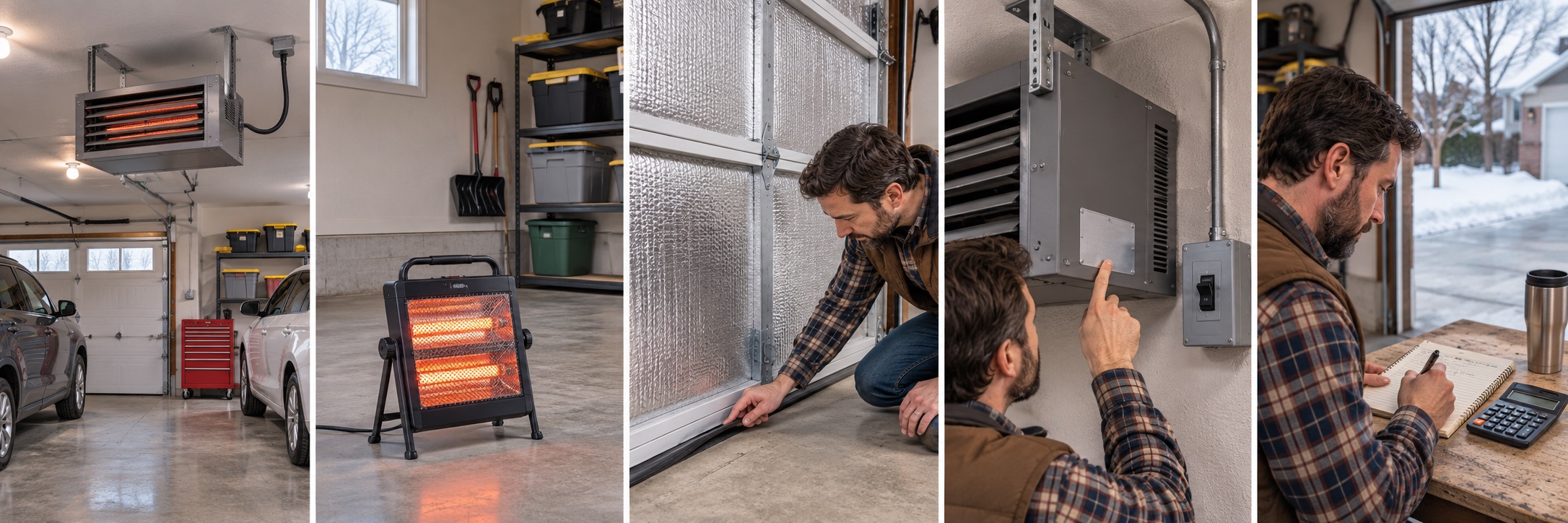
The heater’s rated watts may be constant while the hours it runs change substantially. Check the garage door’s weather seals, gaps around personnel doors, window leakage and exposed ducts. Keep required combustion-air openings, electrical equipment clearances and fire separations as designed; do not seal an opening that serves a safety or ventilation function. A homeowner can document obvious drafts, but repairs to wiring, gas equipment or fire-rated construction need a qualified professional.
A programmable schedule can limit heat to occupied periods if the heater’s control system allows it. A lower setback temperature may reduce runtime, but recovery can take longer. Think through the intended comfort level, tools or materials stored there, freeze protection needs, and manufacturer limits before choosing settings. Do not assume that heating the garage to a high temperature is necessary simply because the unit is rated to do so.
Compare electric resistance with alternatives carefully
Many fixed electric garage heaters use resistance heat. Their cost is straightforward to estimate from kWh, but the comfort and operating cost depend on the actual conditions. A heat pump may use less electricity to deliver the same heat in suitable conditions, but equipment ratings, cold-weather capacity, installation cost, defrost behavior and local electricity and fuel prices all matter. A propane or natural-gas heater has fuel and venting costs plus safety and code requirements. Do not compare only the appliance purchase price or rated watts.
Read your bill rate and charge structure
Use the variable energy rate that applies during the heater’s operating hours. A time-of-use plan may have separate peak and off-peak prices, and some tariffs include demand charges or seasonal adjustments. A residential consumer’s total bill divided by kWh may include fixed charges and taxes; it is not always the right marginal price for one additional heater. Check the current rate schedule or Electricity Facts Label and confirm that the billing period reflects the same price assumptions.
The calculation does not include a new circuit, wiring, electrician, insulation work or equipment purchase. It does not include all delivery charges unless you intentionally incorporate the applicable variable charge. Label any example rate and operating schedule so a reader can replace them with local figures.
Garage heater safety is non-negotiable
Follow the manufacturer’s installation and clearance instructions. Keep combustible material, fuel containers, sawdust, paper, clothes, vehicles and stored items away from hot surfaces and required clearances. Do not cover a heater or block the air intake or outlet. A portable electric heater should be stable, used in a dry location, and plugged in as directed; CPSC advises keeping portable electric heaters at least three feet from combustible items and not powering them through extension cords or power strips. Check your heater manual for its specific requirements.
If plugs or outlets are hot, discolored, loose or produce a burning odor, stop using the equipment. Do not repeatedly reset a tripped breaker; have an electrician investigate. Never use outdoor fuel-burning equipment indoors, and do not disable tip-over or over-temperature protection. A cost estimate cannot determine whether a garage circuit, heater or ventilation setup is safe.
Turn the estimate into a seasonal budget
Create a weekly estimate for a cold week and a milder week, then multiply by the expected number of each type. Record actual usage from the bill or meter when possible. If the garage shares a circuit with other equipment, the bill alone may not isolate the heater’s use; a compatible circuit or appliance measurement is more specific. Compare winter bills using daily kWh and temperature conditions, not totals for billing periods of different lengths.
The result is a planning range, not a guaranteed bill. It helps answer what sustained heater operation could cost at your stated rate. It does not decide the heater size, approve a wiring project, or guarantee savings from insulation. Use an HVAC professional or electrician for design and installation questions.
What does a 1,500-watt garage heater cost per hour?
At full power it uses 1.5 kWh per hour. Multiply 1.5 by your variable price per kWh; at an example $0.18 rate the energy portion is $0.27 per full-load hour. Thermostat cycling can lower actual use, while colder conditions can increase runtime.
Can I estimate from garage square footage?
Floor area alone is not enough. Ceiling height, door leakage, insulation, outdoor temperature, equipment type and target temperature determine heat loss. Use the heater label for electrical input and measure or estimate actual runtime.
Is a ceiling heater cheaper than a portable heater?
The electricity cost depends mainly on actual kWh and rate, not the mounting style. Purchase, installation, circuit changes, airflow, thermostat behavior and safe clearances are separate considerations.
Can I run it from an extension cord?
Follow the exact heater instructions. CPSC warns against powering portable heaters with extension cords or power strips. Fixed heaters may require dedicated wiring by a qualified electrician.
Why does my heater stay on for hours?
A poorly insulated space, open door, thermostat location, heater capacity or very low outdoor temperature can increase runtime. If it cannot maintain comfort or a circuit becomes hot or trips, stop and get qualified help.
Sources and limits
Use the heater's own nameplate and installation manual; this estimate does not size a heater or verify a circuit. CPSC's portable heater safety guidance advises on placement and portable-heater connections. The Department of Energy's home energy checklist discusses air sealing and insulation measures that can affect heating demand; it does not predict the cost of a particular garage. Follow product instructions and local electrical and building codes; have fixed wiring reviewed by a qualified professional.
Compare related heating costs
See the space heater cost guide and electric furnace cost guide for other equipment. To see what changed in your statements, use the two-bill comparison tool.
All electricity guides · Compare plan costs · Methods and limits · Editorial standards