UNDERSTAND EVERY LINE
Electric bill taxes and fees: how to read the line items
BillMellow Editorial · Updated November 8, 2026
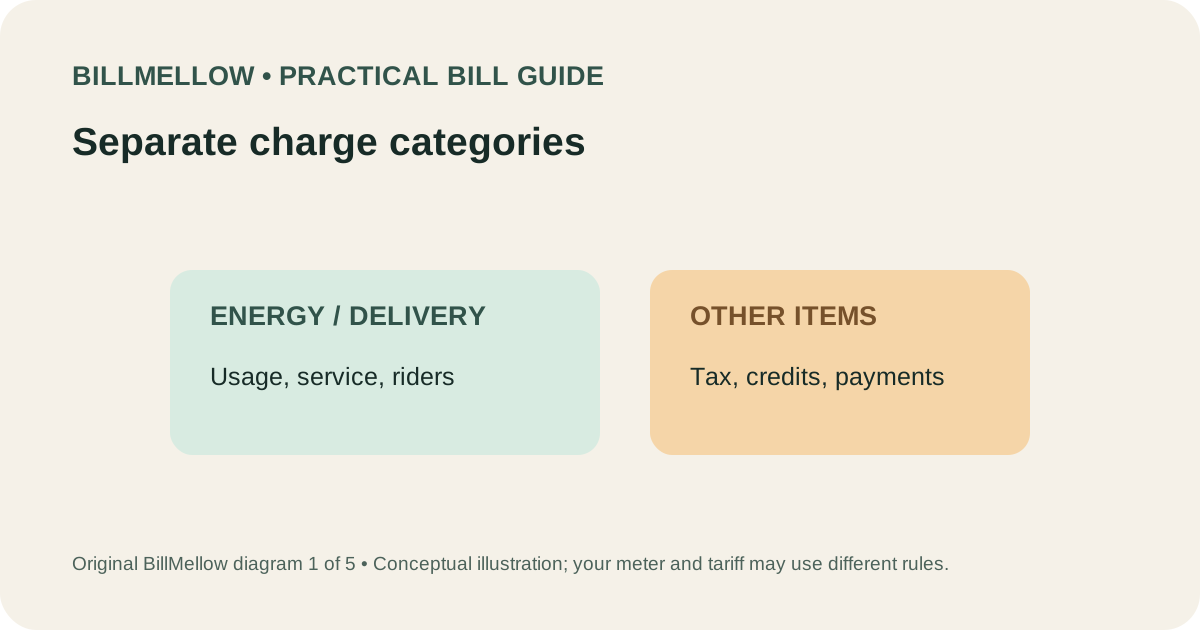
Electric bills can combine energy charges, delivery charges, fixed service fees, taxes, riders, credits, and past-due balances. A line called “fee” is not necessarily a tax, and a tax is not necessarily calculated from kWh alone. The label, calculation base, jurisdiction, provider, and effective rate schedule determine what a particular charge means.
There is no single nationwide list or percentage that applies to every U.S. electric bill. City, county, state, and utility rules can differ; customer type and service territory can matter too. This guide provides a method to categorize and verify the lines without assuming that an item is incorrect or avoidable. For account-specific treatment, use the current bill and official rate schedule, tax authority, or utility explanation.
Common taxes, fees, riders, and credits
Taxes may be imposed under state or local law and can be calculated as a percentage, flat amount, or according to a defined tax base. Taxability can depend on the customer, service, locality, and component. Do not assume every bill line is taxed the same way, and do not apply a general internet tax rate to an electric statement.
Fixed customer or service fees may pay for account, meter, or service availability and may not move directly with kWh use. A customer charge can appear even when consumption is low. Its exact title and purpose depend on the utility's terminology and rate schedule. Compare a full fixed-charge period with another full period rather than dividing the amount by daily kWh and treating it as a usage price.
Riders and adjustments can recover costs or reconcile particular approved items. Examples in DOE materials include fuel cost recovery and energy-efficiency cost recovery factors. A rider may be per kWh, per kW, fixed, or calculated through another provision, and may change when an approved rate or recovery period changes. The word “rider” describes a rate mechanism, not necessarily a tax or one uniform charge.
Fees, penalties, and account items may include a late payment charge, returned-payment fee, deposit, service fee, or other contractual item. Some are triggered by an account event; others can be recurring. Verify the statement's label, event date, and provider's terms before assuming it is optional or recurring.
Credits and adjustments reduce or revise a balance. A credit might come from a correction, program, payment, solar arrangement, or previous overcollection. Confirm which period and line it applies to. A credit can make the total lower while the gross charges have increased, so compare both the before-credit charges and final amount due.
Identify how each amount is calculated
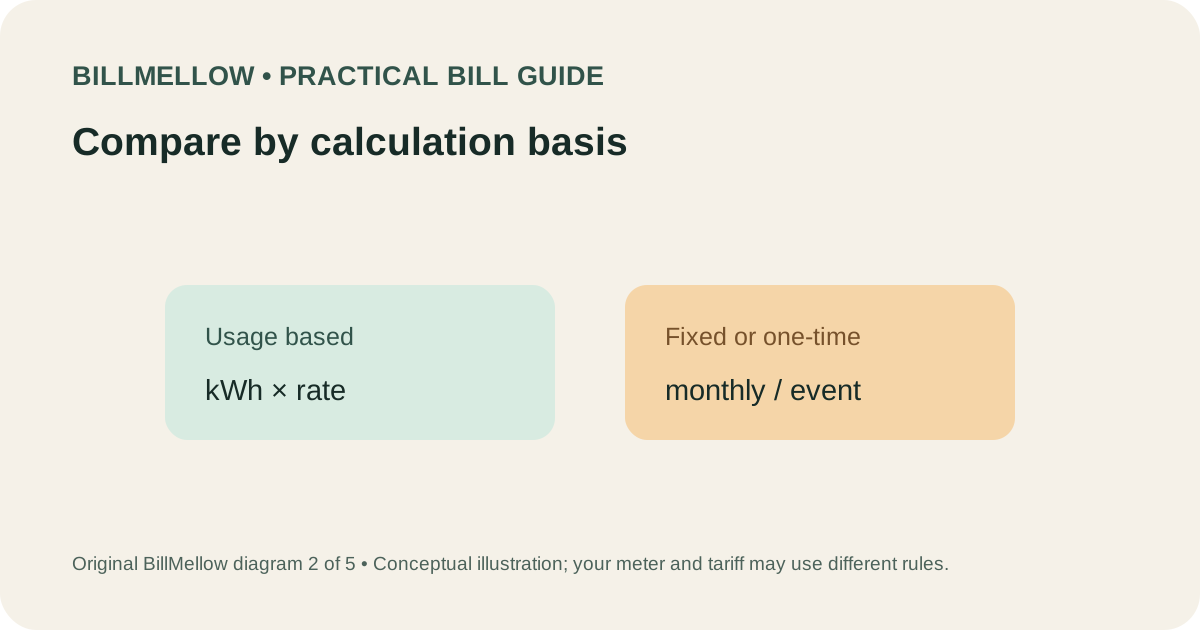
For each line, write down the unit and the quantity it uses: dollars per kWh, dollars per kW, dollars per month, a percentage, number of days, or a one-time amount. A simple usage line might equal kWh multiplied by a stated price. A fixed monthly fee may be prorated or applied according to billing days. A tax might use a taxable subtotal that excludes some items. If a line is a rider, the rate schedule or rate sheet should explain its base and formula.
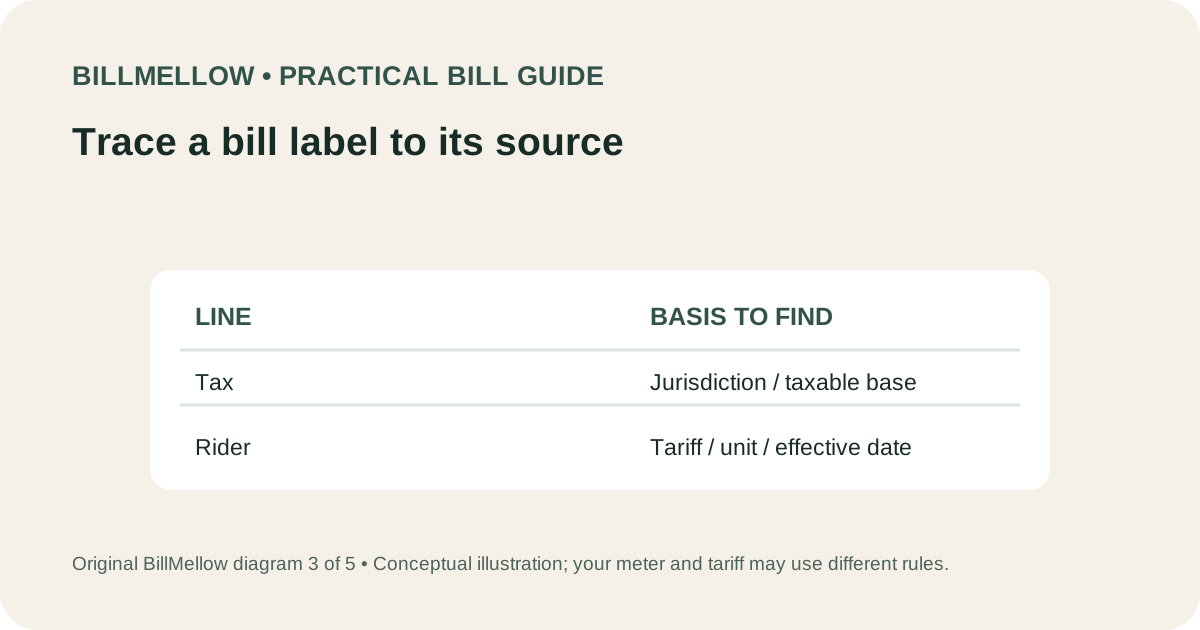
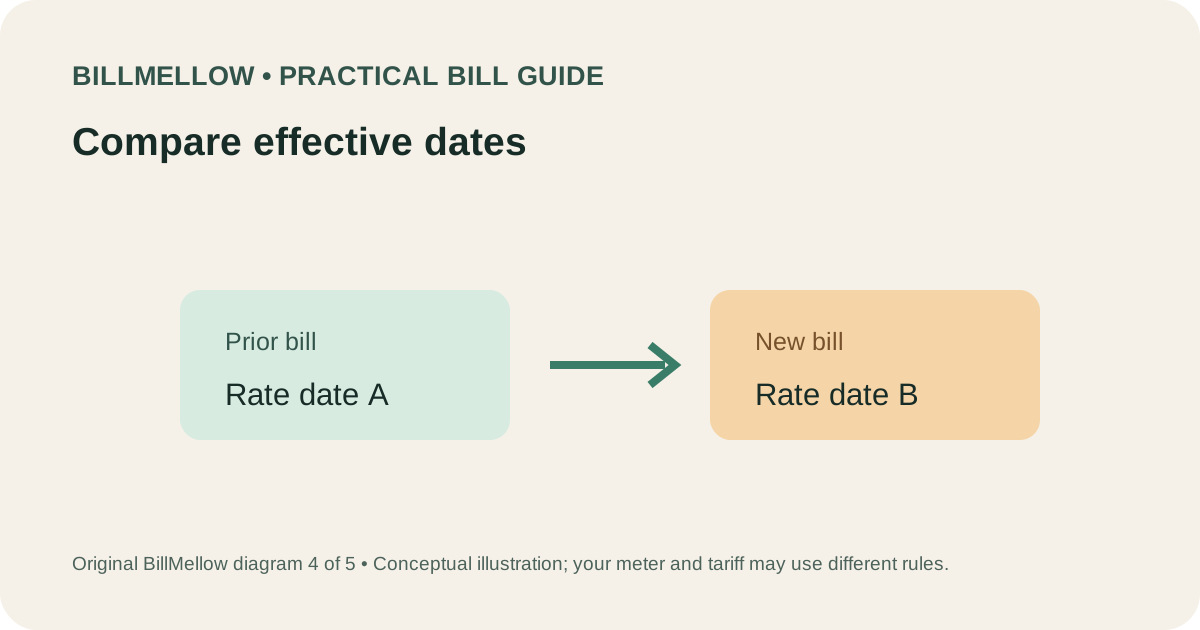
Where the statement offers a rate code, rate schedule link, or tax description, save it with the bill period. The current web page may show today's rate, while an older bill used a prior approved rate. Record the effective date so you compare the correct schedule. If the provider has separate supply and delivery, do not assume the same organization sets every component.
For a quick all-in average, people sometimes divide total dollars by total kWh. That is a blended average, not necessarily the price of one additional kWh. It can include fixed fees, taxes, demand charges, credits, and one-time adjustments. For understanding a new or removed line, isolate that line and the units it uses. See our guide to supply versus delivery charges and the article on fuel adjustment charges.
Why taxes and fees can change from month to month
The bill total can change because usage, prices, billed days, taxes, rider rates, account events, or credits changed. A longer read period can increase kWh and variable charges. A new effective rate schedule can change a per-unit rate. A corrected meter read can add or subtract prior-period use. A tax amount might change when the taxable subtotal changes even if the tax rate itself did not.
Some adjustments appear only in certain billing periods, or are recalculated periodically. A rider's name may stay the same while its factor changes. A local tax or approved charge might be updated. A bill can also show the same usage but a different due amount because of a payment, deposit, late charge, budget plan balance, or prior balance. Examine line items and account activity instead of attributing the full difference to electricity consumption.
When moving or changing service, billing periods can be shorter or overlap in ways that affect fixed items. Make sure bills belong to the intended service address and dates. Do not compare one bill that includes a deposit or past due amount with another that does not without separating those account items.
A line-by-line review checklist
- Confirm service details. Check customer name, service location, account and meter identifiers, and bill dates. Redact these if you share a statement for help.
- Classify each line. Mark it as energy, delivery, fixed service, demand, tax, rider, credit, payment, penalty, or other.
- Record the unit. Note kWh, kW, days, percent, flat amount, or another basis.
- Compare prior periods. Align dates, usage, customer class, rate effective dates, and read status.
- Check the source document. Use the rate schedule, official tax authority, or provider guide that applied on the statement dates.
- Reproduce available math. Multiply only published quantities and rates; preserve credits and taxes as separate steps.
- Ask about unexplained items. Request a written label definition, formula, effective date, and responsible entity.
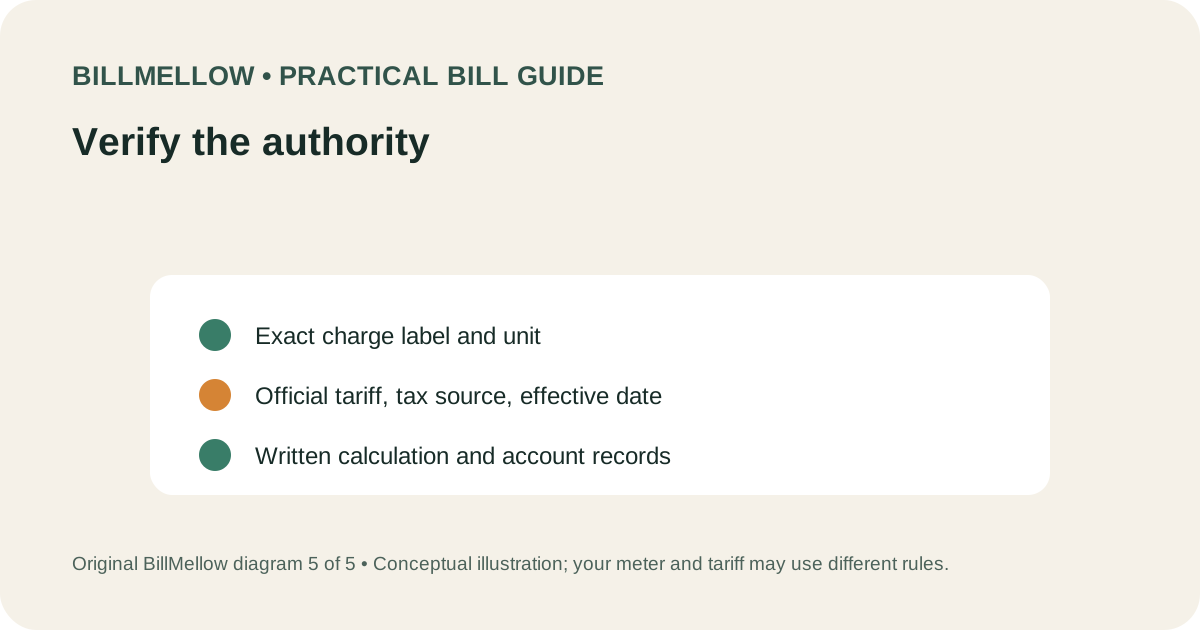
If you find an apparent mismatch, contact the utility through its verified website or the number printed on the bill. Ask whether the line is set by the utility, a supplier, a government authority, or another program. If a tax question is involved, ask which agency or official document supports the treatment. Keep the case number and response. Filing and appeal procedures differ by place, so follow the instructions from the responsible regulator or tax office.
Questions to ask the provider
- What does this exact line-item label mean on my rate?
- Is the amount based on kWh, kW, days, a percentage, or a flat charge?
- What rate or tax schedule and effective date did you apply?
- Which agency or rate schedule authorized the charge, if applicable?
- Does the line apply to supply, delivery, or the whole bill subtotal?
- Was the amount affected by an estimated read, prior adjustment, or account balance?
- Can you provide the calculation and the official source in writing?
Frequently asked questions
Are all electric bill fees taxes?
No. Bills may have fixed customer charges, riders, delivery charges, fees, penalties, deposits, and taxes. Read the label and the rate schedule or official description to distinguish them.
Can I avoid a fixed customer charge by using less electricity?
Not necessarily. A fixed charge is usually set by the rate schedule rather than kWh consumption. Eligibility for another rate depends on the utility and location.
Why did the tax increase if my tax rate did not?
The taxable subtotal, service days, taxable components, or local rules may have changed. Ask the provider which base and rate were used.
Does a rider mean the utility added an unauthorized fee?
Not by itself. A rider can be a rate schedule mechanism, but its authority and calculation should be verifiable in current official documents.
Can I use the average price per kWh to compare two bills?
It can be a rough all-in measure, but it mixes items with different bases. For a specific line or plan, compare matching charges and separate fixed, usage-based, demand, tax, and credit items.
Sources and limits
The DOE Better Buildings resource Understanding Your Utility Bills: Electricity describes riders, fixed fees, penalties and taxes as possible bill components and advises checking the provider's rate documentation. Massachusetts' public utility consumer page, Understanding your electric bill, gives location-specific examples of adjustment factors. Those examples do not apply automatically outside that jurisdiction.
This article is general education and is not tax, legal, or utility-account advice. Exact line items are controlled by current local law, rate schedule, and service terms. BillMellow does not access provider accounts. Use the bill review checklist or the private two-bill comparison tool to organize statement values.