HEATING COSTS · BILLMELLOW GUIDE
Electric Baseboard Heating Cost: Estimate Your Monthly Bill
BillMellow Editorial · Updated November 6, 2026
Calculate electric baseboard heater cost from rated watts, thermostat runtime and your electricity rate. Compare room-by-room use and safer ways to reduce demand.
The calculation
Heater watts ÷ 1,000 × equivalent full-output hours × variable $/kWh. Add each heater’s kWh across rooms; thermostats cycle, so use measured usage or realistic runtime scenarios.
Illustration: a 1,500 W baseboard heater delivering full output for 6 equivalent hours per day uses 9 kWh/day. At an assumed 18¢/kWh that is $1.62/day, or $48.60 for 30 days. If the thermostat cycles at half that equivalent runtime, energy is about $24.30. This estimate excludes other home loads and fixed charges.
Read each heater’s rated power
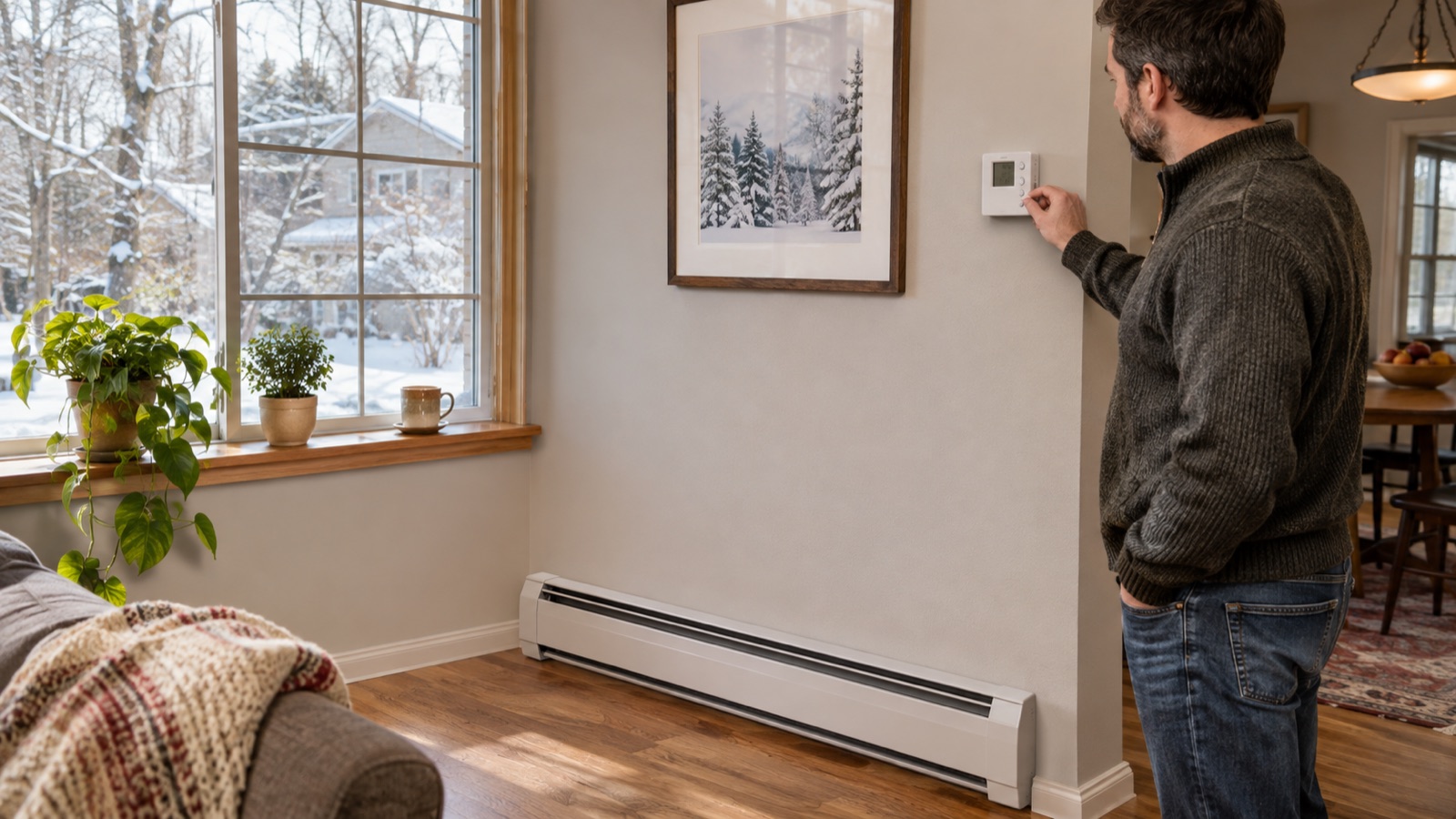
Baseboard heaters are commonly labeled by watts, voltage and model. Record each unit by room instead of treating the entire home as one appliance. The thermostat may cycle the element on and off; rated watts multiplied by all hours in the day is a maximum-style calculation, not a typical cost unless the element runs continuously.
For hardwired heaters, do not connect plug-in meters or extension cords. Use nameplate information, approved utility usage data or a qualified electrician’s measurement. If you are unsure which thermostat controls a unit, test settings cautiously while keeping indoor temperature safe for occupants and pipes.
Why room-level heat can add up
A single heater can draw a meaningful amount while energized, and multiple rooms can operate at once. Outdoor temperature, insulation, exterior wall exposure, window leakage, room doors and thermostat settings influence how often each element cycles. Heating a seldom-used room still adds cost if its thermostat is set high or the door allows heat to move.
Keep required manufacturer clearances around furniture, curtains and bedding. Never cover a baseboard heater or block its airflow. Follow the equipment manual and local fire-safety instructions. Air sealing and insulation may reduce heat loss, but any work near electrical equipment should be done safely and by qualified help when required.
Choose a fair electricity price
Use the usage-based rate on the actual bill. Add supply and delivery components that vary with kWh if they are separate. Keep fixed customer charges, deposits, late fees, taxes and prior balances distinct. If the bill uses a tiered rate, baseboard heat could move consumption into another tier, so a single price may not reflect every additional unit.
If the rate is unclear, find the utility’s current official rate schedule or ask customer service which variable charges apply. Do not rely on a generic state average when estimating a specific household bill. The price for a deregulated supply contract may also be separate from delivery charges, depending on the market and bill layout.
A practical checklist
- List each baseboard heater’s rated watts, room and controlling thermostat.
- Estimate or measure equivalent full-output hours separately by room.
- Keep airflow clear and respect every manufacturer clearance and safety instruction.
- Apply your plan’s usage-based rate, tiers and time-of-use periods.
- Compare kWh per day and ask a qualified professional about abnormal operation.
Frequently asked questions
How much does a baseboard heater cost per hour?
Multiply the heater’s kilowatts by the variable price per kWh. A 1.5 kW unit running at full output for one hour uses 1.5 kWh. Thermostat cycling, rate periods and added delivery charges affect the actual cost.
Do baseboard heaters run at full power all day?
The heating element cycles with thermostat demand. Cold weather, drafts, high settings or a poorly insulated room can lead to longer runtime, but clock hours are not automatically equal to full-power hours.
Is a space heater cheaper than baseboard heat?
Not by default. Compare rated watts, actual hours, the room being heated and whether other areas still receive heat. Safety, circuit capacity and manufacturer instructions must also factor into the decision.
Estimate room use without assuming constant runtime
Check the heater’s rated watts and whether the room has one or several units. For a basic upper-bound scenario, multiply kilowatts by hours only if the heater would draw that input continuously; a thermostat usually cycles as the room warms. Use low, typical, and high runtime assumptions, then compare the range with your bill’s daily kWh. The estimate is not a measurement of the heater’s actual duty cycle.
Baseboard heat is room-specific. Closed doors, drafts, insulation, sun exposure, thermostat placement, and neighboring heated rooms can affect runtime. Lowering a setting may change comfort and energy use, but the result depends on the building and schedule. If a room never reaches the set temperature or the unit behaves unusually, ask a qualified technician to inspect it rather than increasing the setting indefinitely.
Keep the area clear and compare periods fairly
Follow the equipment manual for clearances and keep curtains, bedding, furniture, and stored items away from the heater. Compare bills using service days and kWh per day, especially when weather changed. A smaller energy estimate may not reduce the bill by the same percentage if fixed charges or rates also changed.
Sources and limits
Linked sources provide the basis for this guide. Check them directly for current information, and contact the appropriate utility, agency, or manufacturer about your situation.
For more bill context, read how to read your electric bill or track monthly usage.